Cancel Sunlight Financial Loan: Bankrupt Installer [Guide]
Step-by-step guide and copyable legal dispute letter to cancel or freeze a Sunlight Financial solar loan after your installer files Chapter 7 bankruptcy.
Disclaimer: This article provides factual consumer-protection information and legal analysis. It does not constitute formal legal advice. If you are facing ongoing loan collections or an impending lawsuit, consult a licensed consumer-protection attorney in your jurisdiction.
Direct Answer To cancel or freeze a Sunlight Financial solar loan after your installer enters bankruptcy, homeowners can assert assignee liability under the federal FTC Holder Rule (16 C.F.R. § 433.2). Because Sunlight Financial and originating lenders like Cross River Bank purchase consumer credit contracts containing the mandatory Holder Rule notice, you retain the legal right to assert all claims and defenses against the loan holder that you could bring against the bankrupt installer—including breach of contract, failed inspection, and failure of consideration.
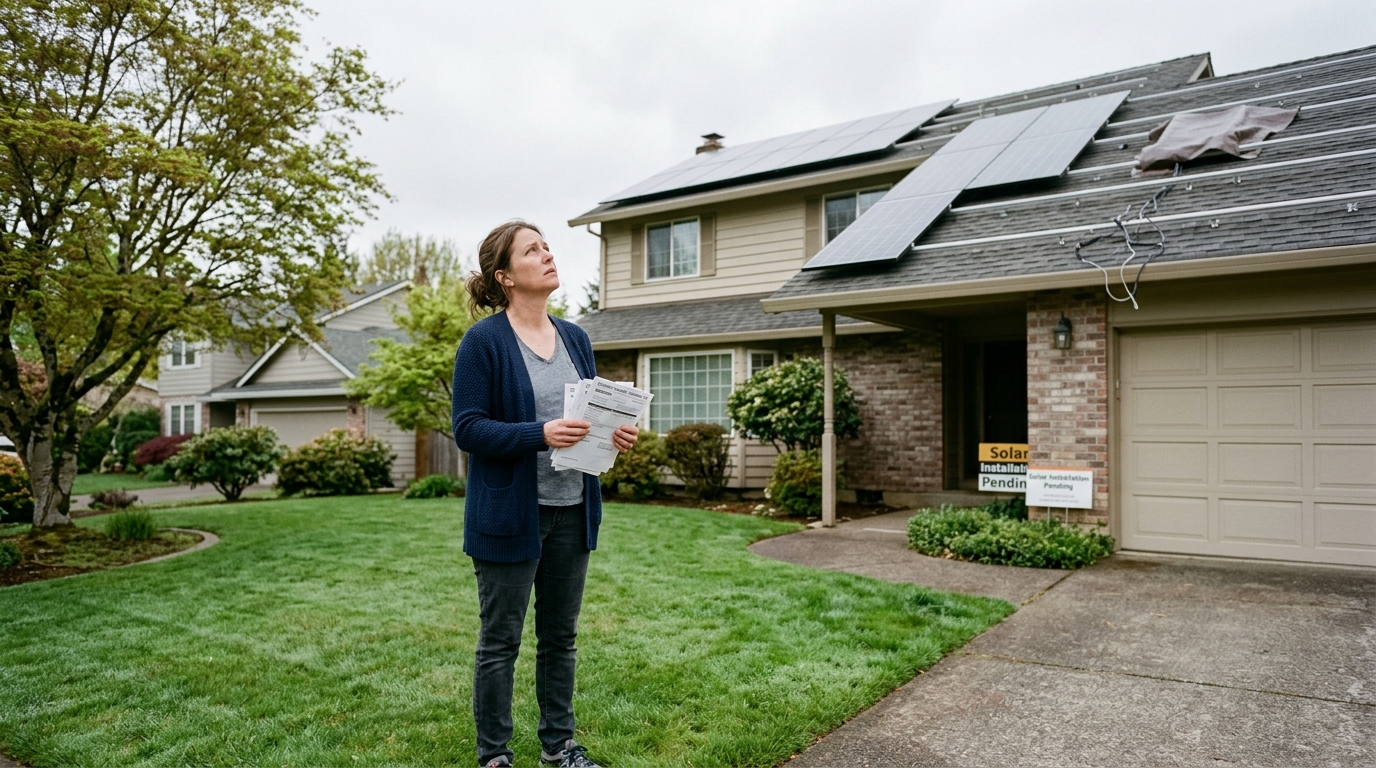
The "Zombie System" Nightmare: Panels on the Roof, Installer Liquidated, Loan Billing
Over the past three years, the residential solar industry has experienced an unprecedented wave of contractor insolvencies. Major national and regional installation companies—including Vision Solar, Pink Energy (PowerHome Solar), Titan Solar Power, and Suntuity Solar—abruptly halted operations and filed for Chapter 7 liquidation.
For thousands of American homeowners, these bankruptcies did not just mean a lost warranty; they created what consumer advocates call "zombie systems":
- Solar panels are bolted to the roof, but electrical wiring is incomplete or failed municipal building inspections.
- The local utility company refused to grant Permission to Operate (PTO) or install the bidirectional net meter.
- The system has generated literally zero kilowatt-hours of clean electricity.
- Yet every single month, Sunlight Financial (or its post-bankruptcy servicing partners) automatically drafts $180 to $350 from the homeowner’s checking account.
When desperate consumers contact customer support, they are routinely met with a scripted wall.
"Sunlight Financial is an independent financing platform, not the solar contractor. We funded your promissory note with Cross River Bank. Your payment obligation is completely separate from your installer’s operational status or warranty obligations."
Under federal consumer-protection law, that statement is fundamentally misleading. Before taking action, run your contract through our Solar Contract Red Flag Checker to identify predatory terms and organize your proof with our Solar Scam Evidence Checklist.
Understanding the Legal Shield: The FTC Holder Rule (16 C.F.R. § 433.2)
To prevent lenders from financing predatory merchant schemes and then hiding behind "holder in due course" immunity, the Federal Trade Commission established the Preservation of Consumers' Claims and Defenses Rule, commonly known as the FTC Holder Rule (16 C.F.R. Part 433).
Federal law requires consumer credit contracts to include this explicit text in bold capital letters.
"ANY HOLDER OF THIS CONSUMER CREDIT CONTRACT IS SUBJECT TO ALL CLAIMS AND DEFENSES WHICH THE DEBTOR COULD ASSERT AGAINST THE SELLER OF GOODS OR SERVICES OBTAINED PURSUANT HERETO OR WITH THE PROCEEDS HEREOF."
How the Holder Rule Dismantles Sunlight Financial's Defense
- Lenders Step into the Installer's Shoes: When Sunlight Financial facilitates a solar loan through Cross River Bank or another bank-of-record, the promissory note incorporates the FTC Holder Rule notice. The lender legally steps into the shoes of the installer.
- Defenses Against the Seller Apply to the Lender: If Vision Solar, Pink Energy, or Titan Solar committed fraud, failed to complete the installation, abandoned unpermitted electrical hazards, or violated state building codes, the homeowner has a valid defense against the seller. Under the Holder Rule, that exact same defense applies against Sunlight Financial.
- Offsetting and Extinguishing Balances: The homeowner can legally withhold future payments, demand the loan balance be zeroed out, seek refund of payments made up to the statutory cap, and compel the release of any recorded UCC-1 property liens.
In landmark litigation such as Migliore v. Vision Solar & Sunlight Financial (3rd Cir., cert. denied June 2026), federal courts have affirmed that consumers forced into arbitration or court can assert substantive contractor defenses directly against Sunlight Financial and its funding partners.
Step-by-Step Action Plan: Challenging a Sunlight Loan on a Stranded System
If your solar installer has entered Chapter 7 or Chapter 11 bankruptcy and left you with an inoperable system while Sunlight Financial continues billing, follow this protocol.
Step 1: Secure Utility and Municipal Inspection Records
Do not rely on verbal statements. You must establish conclusive proof that the installer failed to deliver a functional, legal power plant:
- Contact your municipal building department and request the official permit jacket and inspection log. If the electrical or structural permit was "red-tagged" or never finalized, obtain a certified copy.
- Contact your electric utility's interconnection department and request written confirmation that Permission to Operate (PTO) was never granted, or the date interconnection was rejected.
Step 2: Audit Your Original Proposal and Promissory Note
Pull your original sales contract and your Sunlight Financial loan agreement:
- Identify the exact originating bank (frequently Cross River Bank).
- Check the disbursement schedule: Did Sunlight disburse 100% of the loan proceeds to the installer before municipal inspection and utility PTO were achieved? Lenders that release final milestone funds without verifying operational status violate industry underwriting standards.
Step 3: Issue a Formal Written Dispute and Revoke ACH Authorization
Do not just call customer service. Telephone conversations leave no admissible evidentiary trail.
- Send a formal Notice of Consumer Defense under 16 C.F.R. § 433.2 via Certified Mail with Return Receipt Requested to Sunlight Financial and the loan servicer.
- Explicitly state: "Pursuant to the FTC Holder Rule incorporated into promissory note #[LoanNumber], I hereby assert the seller's complete failure of consideration, abandonment, and breach of contract as a defense against further payment obligations."
- Revoke automated ACH drafting permissions in writing under Regulation E (12 C.F.R. § 1005.10(c)) and notify your bank to place a stop-payment order on all future drafts from Sunlight Financial.
Verbatim Dispute Template: Notice of Defense under FTC Holder Rule (16 C.F.R. § 433.2)
Copy, fill in the bracketed fields, and send via USPS Certified Mail with Return Receipt Requested.
[Date]

VIA CERTIFIED MAIL — RETURN RECEIPT REQUESTED
To: Sunlight Financial LLC / Loan Servicing Department
    c/o Compliance & Legal Disputes
    [Servicer Address from Statement]
Copy: Cross River Bank
      c/o Consumer Lending Compliance Desk
      885 Teaneck Road, Teaneck, NJ 07666

RE: FORMAL NOTICE OF DEFENSE AND DEMAND FOR LOAN NULLIFICATION
    PURSUANT TO THE FTC HOLDER RULE (16 C.F.R. § 433.2)
    Borrower Name: [Your Full Name]
    Co-Borrower (if applicable): [Co-Borrower Name]
    Property Address: [Your Property Address]
    Loan Account Number: [Your Sunlight Loan Account #]
    Originating Solar Contractor: [e.g., Vision Solar LLC / Pink Energy / Titan Solar]

Dear Sunlight Financial Compliance & Dispute Resolution Desk.

Please be advised that I am the borrower on the above-referenced consumer credit transaction originated through Sunlight Financial LLC and funded by Cross River Bank.

I am writing to provide formal, authenticated notice that I am asserting affirmative defenses and claims against the holder of this contract pursuant to the Federal Trade Commission's Preservation of Consumers' Claims and Defenses Rule, 16 C.F.R. § 433.2 (the "FTC Holder Rule"), which is expressly incorporated into my promissory note.

"ANY HOLDER OF THIS CONSUMER CREDIT CONTRACT IS SUBJECT TO ALL CLAIMS AND DEFENSES WHICH THE DEBTOR COULD ASSERT AGAINST THE SELLER OF GOODS OR SERVICES OBTAINED PURSUANT HERETO OR WITH THE PROCEEDS HEREOF."

FACTUAL BASIS FOR ASSERTION OF CLAIMS & DEFENSES:
1. Complete Failure of Consideration: The originating contractor, [Name of Installer], has abruptly ceased business operations and entered liquidation bankruptcy (Bankruptcy Case No. [Case #, if known]).
2. Non-Functional / Abandoned System: The solar equipment installed at my property has never received Permission to Operate (PTO) from my electric utility, [Utility Company Name], and has failed municipal building inspection (Permit No. [Permit #]). The system produces zero usable electrical power.
3. Total Breach of Warranty: The 25-year installation, production, and workmanship warranty promised in the sales agreement is completely unfulfilled and legally abandoned.
4. Premature Disbursement of Funds: Sunlight Financial disbursed consumer loan proceeds to the contractor without verifying municipal final inspection or utility interconnection.

FORMAL DEMANDS:
1. Immediate Cessation of Billing: Immediately place this account in administrative dispute status and suspend all monthly billing, interest accrual, and payment demands.
2. Revocation of ACH Drafting: Pursuant to Regulation E ([12 C.F.R. § 1005.10(c)](https://www.consumerfinance.gov/rules-policy/regulations/1005/10/#c)), I hereby immediately revoke any and all prior authorization for Sunlight Financial, Cross River Bank, or their agents to initiate automatic ACH electronic fund transfers from my bank account.
3. Credit Bureau Non-Derogatory Notice: Pursuant to the Fair Credit Reporting Act ([15 U.S.C. § 1681s-2](https://www.law.cornell.edu/uscode/text/15/1681s-2)), you are instructed to report this tradeline as "Account in Dispute - Disputed by Consumer" and refrain from reporting any derogatory, late, or delinquent marks during the pendency of this bona fide dispute.
4. Extinguishment of Balance & Release of Liens: Take immediate steps to zero out the outstanding promissory balance and record a UCC-3 Termination Statement under [UCC § 9-513](https://www.law.cornell.edu/ucc/9/9-513) in the county property records to extinguish any [UCC-1 fixture filing](https://www.law.cornell.edu/ucc/9/9-502) encumbering my real property parcel.

Please provide written confirmation of receipt and your substantive written response within thirty (30) calendar days of receipt.

Sincerely,

_________________________________________
[Your Signature]
[Your Printed Name]
[Your Phone Number]
[Your Email Address]
Installers in Sunlight Financial's Portfolio: Current Bankruptcy Status
Thousands of active Sunlight Financial loans are tied to defunct installation entities. Review your contract paperwork for these liquidated companies.
| Installer Entity | Bankruptcy Status | Primary Dispute Patterns |
|---|---|---|
| Vision Solar | Chapter 7 Liquidated | Unpermitted wiring, structural roof rot, $5M CT AG penalty, forged digital signatures. |
| Pink Energy (PowerHome) | Chapter 7 Liquidated | Defective Generac SnapRS cutoff switches, false tax credit projections, multi-state AG actions. |
| Titan Solar Power | Chapter 7 Liquidated (June 2024) | Abandoned installations mid-construction, stranded interconnection filings, absent warranties. |
| Suntuity Solar | Chapter 7 Liquidated | Abrupt cessation of operations, unfulfilled permit fees, utility interconnect rejections. |
| Lumio Solar | Chapter 11 Restructured (Sept 2024) | High-pressure door-to-door sales, unfulfilled service tickets, production guarantee defaults. |
What Happens When You Freeze Payments? Credit Reporting & Arbitration
Many homeowners hesitate to challenge Sunlight Financial out of fear that the lender will destroy their credit score or foreclose on their home. Here is the legal reality:
- FCRA Protections: When you submit a formal, documented billing and fraud dispute under the Fair Credit Reporting Act (FCRA, 15 U.S.C. § 1681s-2), the furnisher (Sunlight / Cross River Bank) cannot legally report the account as a simple delinquent default without noting that the balance is disputed.
- AAA Consumer Arbitration: Sunlight Financial contracts contain mandatory arbitration clauses administered by the American Arbitration Association (AAA). Under AAA Consumer Arbitration Rules, Sunlight Financial is required to pay nearly all filing and arbitrator fees (often exceeding $3,500–$5,000 per case), while the consumer's fee is capped at $200. When presented with a well-documented Holder Rule claim, lenders frequently choose to settle, modify the balance, or release the debt rather than fund expensive individual arbitrations.
FAQ
Can Sunlight Financial sue me if my installer went bankrupt?
While lenders theoretically retain the right to pursue collections on unpaid promissory notes, Sunlight Financial faces severe legal exposure under the FTC Holder Rule when the underlying installation was never completed or permitted. If they attempt to collect on an abandoned, non-functional system, homeowners can countersue for statutory violations of state Unfair and Deceptive Acts and Practices (UDAP) laws.
How do I prove my system was never turned on?
Request a formal letter or email from your local electric utility's interconnection desk stating whether Permission to Operate (PTO) was ever granted. Utility smart meters record hourly net generation; an export log showing zero kilowatt-hours fed to the grid is indisputable evidence of non-operation.
Who is responsible for my 25-year solar warranty if the installer is gone?
Equipment manufacturers (such as Enphase, SolarEdge, or panel producers) typically maintain separate warranties on the hardware itself. However, the workmanship and labor warranty died with the bankrupt installer. Under the FTC Holder Rule, the loss of this contractually promised 25-year service warranty constitutes a material breach that can be asserted against Sunlight Financial to offset the loan balance.
Does Sunlight Financial put a lien on my house?
Sunlight Financial loans generally involve a UCC-1 fixture filing recorded against the solar equipment in county land records. While not a traditional mortgage lien, this filing appears on title searches and will block a home sale or mortgage refinance unless formally subordinated or terminated with a UCC-3 filing.
How do I settle a Sunlight Financial loan when the installation was never finished and the contractor disappeared?
If a solar contractor or subcontractor vanished with your installation incomplete (leaving missing panels, unpermitted electrical runs, or an unconnected inverter), do not continue quietly paying. Send a formal written dispute under the FTC Holder Rule and Regulation E to Sunlight Financial and its funding bank (e.g., Cross River Bank). Concurrently file complaints with your state Attorney General's Consumer Protection Division and the CFPB documenting failure of consideration. Consumer rights attorneys frequently handle these cases on contingency or statutory fee-shifting, demanding that the lender cancel the remaining balance, refund prior payments, and remove all recorded UCC-1 fixture filings. For our complete step-by-step settlement framework and certified dispute letter template, see our dedicated guide: Settling a Sunlight Financial Loan for an Unfinished Install.
Sources and Official References
- Federal Trade Commission: The Holder Rule (16 CFR Part 433)
- FTC Business Guidance: Preservation of Consumers' Claims and Defenses
- Consumer Financial Protection Bureau: Solar Financing Research and Consumer Reports
- CFPB Regulation E: Electronic Fund Transfers (12 CFR § 1005.10)
- Cornell Law LII: Fair Credit Reporting Act Furnisher Requirements (15 U.S.C. § 1681s-2)
- Cornell Law LII: UCC § 9-513 (Termination Statement)
- State of Minnesota AG: Enforcement Action Against GoodLeap, Sunlight Financial, Mosaic, and Dividend
- U.S. Bankruptcy Court for the District of Delaware: In re Sunlight Financial Holdings Inc., Case No. 23-11802
- U.S. Court of Appeals for the Third Circuit: Migliore v. Vision Solar LLC and Sunlight Financial LLC, Docket No. 23-2891
Next Research Steps
Use these resources to connect this issue with the broader solar scam pattern, the relevant legal framework, and the next practical action.
Solar panel scams
Start with the main solar panel scams guide for the broad definition and recovery roadmap.
Solar financing fraud compensation
Use this guide for loan, dealer-fee, payment-jump, PACE, lease, and lender-defense issues.
Homeowner legal rights
Review cancellation, rescission, UDAP, TILA, Holder Rule, arbitration, and lawsuit options.
Solar company complaint directory
Look up installers, lenders, bankruptcies, warranty problems, and customer-service complaint patterns.
Trapped in a predatory loan?
FTC Holder Rule & cancellation rights