Sunlight Financial Installer Partners: Every Company That Put Homeowners at Risk
Named list of Sunlight Financial's solar installer dealer network — bankruptcies, AG lawsuits, forged contracts, and what victims can do now.
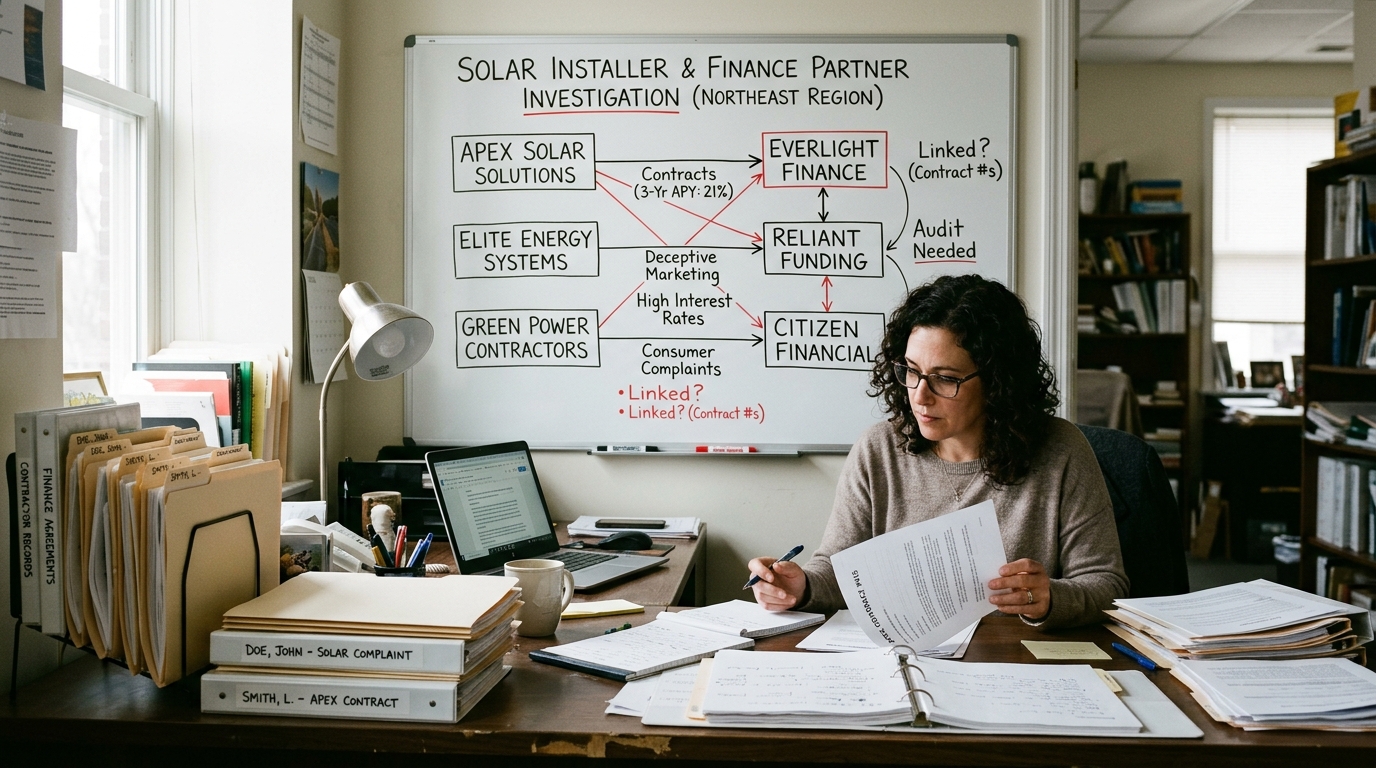
Disclaimer This article is consumer education based on public court dockets, regulatory filings, state AG actions, CFPB complaints, and SEC disclosures. It does not constitute legal advice. Claims against specific installers are described as alleged or documented in public records. If your installer appears on this list, consult a licensed consumer-protection attorney.
Why the Installer Name Matters
Lenders frequently obscure a fundamental reality: Sunlight Financial's legal exposure is directly tied to its installer relationship.
Sunlight didn't knock on your door. Some guy with a tablet from one of the companies below did. He entered your information into Sunlight's dealer portal, generated a DocuSign link, and pocketed a commission funded by a hidden 15% to 40% dealer fee — one that got quietly buried in your loan principal and never showed up on a single page of the sales pitch.
Under the FTC Holder Rule (16 C.F.R. § 433), every defense you have against that installer — fraud, misrepresentation, failure to install, forged signature, breach of warranty — transfers directly to Sunlight Financial and Cross River Bank as the loan holder. They can't run from the installer they chose, vetted, and paid.
So the first question in any Sunlight Financial case is simple: Who installed your panels?
Tier 1: Bankrupt — Systems Abandoned, Collections Active
Tier 1 solar installers entered formal bankruptcy proceedings while homeowners' systems sat dead, uninspected, or incomplete. Sunlight Financial continued collections in most cases.
1. Pink Energy (Powerhome Solar)
Status Chapter 7 Liquidation — Filed October 7, 2022
HQ Mooresville, North Carolina
States Active NC, SC, VA, OH, IN, MI, KY, TN, AL, GA
Pink Energy was one of Sunlight Financial's highest-volume dealer partners and a linchpin of its East Coast loan book. At its peak, it operated in over a dozen states, pushing Generac SnapRS battery and inverter packages through high-pressure door-to-door sales.
The Collapse In September 2022 — weeks before the Chapter 7 filing — Sunlight Financial disclosed a $30 to $33 million impairment loss directly tied to advances made to "one of its largest solar installers." Public records confirmed that installer was Pink Energy. The company filed for liquidation October 7, 2022, abandoning tens of thousands of homeowners with orphaned Pink Energy systems mid-installation or with underperforming Generac systems linked to rooftop thermal shutoff incidents.
The Fraud Pattern
- Reps falsely promised Generac SnapRS units would eliminate electric bills entirely
- Systems were installed before permitting was complete; utility Permission to Operate (PTO) was never obtained in hundreds of cases
- Forged homeowner signatures and initials appeared on multiple Sunlight Financial loan modification pages
- Reps told homeowners to sign DocuSign forms described as "just an inspection acknowledgment"
The AG Response A coalition of nine state Attorneys General — led by North Carolina and Michigan — issued formal demand letters to Sunlight Financial, GoodLeap, Dividend Solar, and Cross River Bank demanding an immediate freeze on collections and interest accrual for all Pink Energy customers. Sunlight largely refused voluntary suspension.
If This Is Your Installer You have strong FTC Holder Rule grounds to cancel your Sunlight Financial loan after installer bankruptcy. The failure to obtain PTO constitutes a material breach of the installation contract. Sunlight Financial knew of the impairment and continued originating loans. Document the impairment timing vs. your loan origination date — that gap is legally significant.
2. Vision Solar
Status Chapter 7 Bankruptcy — Filed 2023
HQ Cherry Hill, New Jersey
States Active NJ, CT, PA, NY, RI, MA
Vision Solar generated more public legal carnage than nearly any other Sunlight dealer — including the case that went all the way to the Third Circuit.
The Fraud Pattern
- Reps posed as representatives from "state clean energy offices" or local utilities
- DocuSign contracts were completed using burner Gmail addresses homeowners had never seen
- Homeowners reported discovering Sunlight Financial loan accounts they had never knowingly opened
- Sales reps obtained utility bills under the guise of "eligibility verification" then used account numbers to push installs through
The Legal Record
- The Connecticut Attorney General obtained a $5 million judgment against Vision Solar for deceptive trade practices, predatory sales, and unpermitted installations
- Migliore v. Vision Solar LLC & Sunlight Financial LLC — U.S. Third Circuit Court of Appeals — held in late 2025 that federal claims require strict agency pleading to establish lender vicarious liability; however, individual arbitrations have continued to void forged Sunlight promissory notes, terminate UCC-1 liens, and award compensatory damages on state law claims that are not subject to the federal pleading standard
- Rhode Island and New Jersey consumer protection divisions received over 400 combined complaints against Vision Solar between 2021 and 2023
If This Is Your Installer The Connecticut AG judgment is your evidentiary foundation. In arbitration, state consumer protection claims (UDAP, CPA) survive the Migliore federal pleading holding. The burner email pattern constitutes identity theft — file a police report in addition to pursuing loan cancellation.
3. Titan Solar Power
Status Chapter 7 Liquidation — Filed June 2024
HQ Gilbert, Arizona
States Active AZ, CA, NV, TX, CO, FL, GA, NM, UT
Titan Solar was one of the largest privately held residential solar companies in the Southwest. It abruptly ceased operations in June 2024 with zero wind-down notice, abandoning thousands of homeowners mid-installation — some with holes cut in their roofs and no panels.
The Collapse Titan's shutdown was sudden and total. Employees showed up to offices locked without notice. Customer service lines went dead. Subcontractors who had performed work went unpaid. Sunlight Financial continued drawing monthly loan payments from homeowners whose systems had never received PTO.
The Fraud Pattern
- Aggressive referral program paid existing customers $500 to $1,000 per new signup — creating social proof fraud
- Contracts disclosed a 25-year system life guarantee backed by "Titan's nationwide service network" — a network that ceased to exist overnight
- Dealer fees embedded in Sunlight Financial loan principals ranged from 28% to 41% of gross system cost
- Multiple Arizona homeowners reported that reps signed their names on completion certificates without performing final inspections
If This Is Your Installer Document the date your system received (or failed to receive) utility PTO vs. Titan's June 2024 closure. Any loan payments made after the system went dark are recoverable under unjust enrichment and FTC Holder Rule defenses. Arizona DTPA allows treble damages for willful misrepresentation.
4. Swell Energy
Status Assignment for Benefit of Creditors (ABC) — 2024
HQ Los Angeles, California
States Active CA, HI, TX, NY, MA
Swell Energy marketed itself as a premium "smart home energy" installer focused on battery storage — Tesla Powerwall, Enphase, and SunPower panels. Its ABC wind-down left customers without warranty support, without PTO in some cases, and with Sunlight Financial loans on systems they couldn't operate.
The Fraud Pattern
- Heavy emphasis on virtual power plant (VPP) revenue sharing promises that never materialized
- Homeowners signed 10-year battery service agreements with Swell that became worthless upon ABC filing
- Sunlight Financial loan documents listed Swell's corporate address as the warranty service contact — an address that became vacant
If This Is Your Installer The failed warranty service agreement is a standalone breach-of-contract claim against the loan estate. California homeowners have additional rights under the Contractor State License Board (CSLB) recovery fund for licensed contractor failures.
5. ADT Solar (formerly Sunpro Solar)
Status Exited residential solar — January 2024
HQ Orlando, Florida
States Active FL, TX, GA, AL, LA, MS, NC, SC, TN, VA
ADT acquired Sunpro Solar in 2021 in a high-profile bet on solar cross-selling through its home security customer base. The bet failed spectacularly. ADT Solar exited the residential solar business entirely in early 2024, laying off its entire solar sales and installation workforce and abandoning thousands of mid-project customers.
The Fraud Pattern
- ADT's brand was used to imply government or utility affiliation ("ADT monitors everything — now your energy too")
- Salespeople leveraged existing ADT home security relationships to introduce solar under the guise of a "loyalty upgrade"
- Sunlight Financial loans originated through the ADT Solar portal carried dealer fees in the 25% to 35% range, embedded without disclosure
- Subcontractors hired by ADT Solar performed installations in states where neither ADT nor the subcontractor held the required residential solar contractor license
The SEC Disclosure ADT's 10-K filings for 2022 and 2023 disclosed Sunlight Financial as a named capital partner for its solar portfolio. The disclosure of the origination relationship creates a documented paper trail linking the lender to ADT's sales practices.
If This Is Your Installer ADT Solar's exit from the market constitutes failure of consideration for any ongoing warranty, maintenance, or monitoring service promised at sale. ADT's publicly traded status means its filings are discoverable in arbitration — a significant leverage point.
Tier 2: Operating but Under Regulatory Scrutiny
Tier 2 solar contractors remain operational — but facing active investigations, lawsuits, or documented complaint patterns tied to Sunlight Financial-funded deals.
6. Momentum Solar
Status Active (restructured)
HQ Somerset, New Jersey
States Active NJ, NY, CT, PA, FL, TX, CA
Momentum Solar generated substantial CFPB complaint volume between 2021 and 2024, with recurring themes of misrepresentation of net metering savings, failure to disclose the dealer fee structure, and — in documented cases — submission of loan applications without homeowner knowledge.
The Pattern Reps obtained utility bills and credit authorization under "eligibility check" pretexts, then submitted full Sunlight Financial applications before homeowners realized they were in the credit pull process. Multiple CFPB complaint narratives describe homeowners discovering hard inquiries on their credit reports from Cross River Bank weeks before any contract was signed.
If This Is Your Installer A credit inquiry submitted without explicit written authorization violates the Fair Credit Reporting Act (15 U.S.C. § 1681b). Demand the written authorization Sunlight Financial claims to possess — if it doesn't exist or is unsigned, you have a federal FCRA claim alongside any state UDAP claim.
7. ION Solar
Status Active
HQ Provo, Utah
States Active UT, ID, OR, WA, CO, TX, AZ, NV, CA
ION Solar built its business on aggressive door-to-door teams operating across Western states. BBB and CFPB complaints concentrate around installation workmanship — specifically roof penetrations that created water intrusion — combined with Sunlight Financial loan payments continuing through multi-month repair delays.
Internal Fraud In 2023, ION Solar itself disclosed internal employee fraud and equipment theft, creating additional questions about inventory management and whether homeowners received the panel models and quantities contracted for.
If This Is Your Installer Request the inspection reports and panel serial numbers from your installation. If the equipment differs from what was contracted and financed, you have a potential loan rescission claim — the loan was for a specific system that was never actually installed.
8. Blue Raven Solar (now Complete Solar / SunPower successor entity)
Status Absorbed through SunPower bankruptcy transition
HQ Orem, Utah
States Active ID, OR, WA, CO, NV, AZ, UT (primary)
Blue Raven was acquired by SunPower in 2021 and rebranded under the SunPower umbrella before SunPower's August 2023 Chapter 11 filing. Homeowners who signed Blue Raven contracts in 2021 through 2023 now find themselves dealing with a three-way chain of installer collapse: Blue Raven → SunPower → Complete Solar (asset acquirer), with Sunlight Financial as the persistent loan holder throughout.
If This Is Your Installer The chain of corporate succession creates a complex warranty claim. Document each entity's role in writing and pursue the warranty obligation against Complete Solar while asserting FTC Holder Rule defenses against Sunlight Financial for the underlying misrepresentations.
9. Palmetto Solar
Status Active
HQ Charleston, South Carolina
States Active SC, NC, GA, FL, VA, TX, CA, and 20+ states through marketplace model
Palmetto operates both as a direct installer and as a marketplace connecting homeowners to third-party local installers. Consumer complaints document material misrepresentations regarding energy production estimates — with actual production running 30% to 45% below salesroom projections — combined with Sunlight Financial loans sized to the inflated savings projection.
The Loan Sizing Problem When a Sunlight loan is sized based on projected monthly savings of $280 but the system produces savings of $160, the homeowner is net negative every month. The loan payment exceeds the savings, the promised "net zero" bill materializes as a higher combined bill, and the homeowner has no legal remedy unless they can prove the production estimate was fraudulent at the point of sale.
If This Is Your Installer Obtain the original production estimate from your proposal — Palmetto typically provides this in the initial PDF. Compare it to actual system output from your monitoring app (enphaseenergy.com, SolarEdge, or similar). A gap of 20% or more is grounds for a misrepresentation claim in most states.
10. Freedom Forever / Freedom Solar Power
Status Active
HQ Temecula, California (Freedom Forever); Austin, Texas (Freedom Solar Power)
States Active Nationwide (Freedom Forever); TX, CO, NM, FL, NV (Freedom Solar)
Note: Freedom Forever and Freedom Solar Power are distinct entities that are frequently confused.
Freedom Forever is one of the largest Sunlight Financial dealer partners by volume, operating through a national franchise-model installer network. The Texas Attorney General issued investigative demands to Freedom Forever in April 2026 citing widespread consumer reports of deceptive sales practices, including misrepresentation of monthly cost savings, failure to disclose dealer fees, and installation delays exceeding 12 months.
The Pattern Freedom Forever's franchise model means local franchise operators — not Freedom Forever corporate — perform the actual sales and installation. When a franchise operator engages in fraud, Freedom Forever corporate attempts to disclaim responsibility while Sunlight Financial points to Freedom Forever as the responsible party. The homeowner is caught in the middle.
If This Is Your Installer The franchise relationship does not shield Freedom Forever from UDAP liability for franchise-level misconduct — many state consumer protection statutes impose liability on the franchisor for franchisee deceptive acts committed under the franchisor's brand. The Texas AG investigation creates evidentiary leverage even for homeowners in other states.
The Cross River Bank Layer
One name that ties most of these installers together — in addition to Sunlight Financial — is Cross River Bank, a New Jersey-chartered fintech bank that acted as the originating lender on most Sunlight Financial solar loans before the loans were packaged and sold to investors.
Cross River Bank has been named in:
- Multiple state AG demand letters following the Pink Energy collapse
- Securities class action litigation alleging the bank knew of systemic dealer fraud and failed to disclose it to investors purchasing the securitized loan pools
- CFPB informal investigation inquiries regarding Cross River's solar loan origination diligence standards
Cross River Bank is a federally chartered bank subject to OCC oversight. If your complaint involves Cross River, you can file directly with the Office of the Comptroller of the Currency (OCC) at 1-800-613-6743 or occ.gov — in addition to the CFPB.
How to Use This List as a Legal Weapon
Finding your installer on this list is not just historical context — it's arbitration ammunition. Here's what the information unlocks.
Step 1: Confirm the Installer-Lender Relationship in Writing
Send a written request to Sunlight Financial (or its successor servicer) demanding:
- The full name of the dealer/installer entity that originated your loan
- The dealer agreement date between Sunlight and that installer
- The dealer fee amount embedded in your loan principal
- All communications between Sunlight and the installer regarding your specific loan file
You are entitled to this under your TILA disclosure rights and, in arbitration, through discovery demands.
Step 2: Pull the AG Record for Your Installer
Every state AG action, BBB complaint aggregate, and CFPB complaint narrative in the public record for your installer is admissible in arbitration as evidence of a pattern of conduct. "Pattern of conduct" evidence dramatically strengthens a claim that Sunlight Financial knew or should have known its dealer was engaging in systematic fraud.
Step 3: Assert the FTC Holder Rule Explicitly
Your written dispute letter to Sunlight Financial must include the phrase: "Pursuant to 16 C.F.R. § 433 (FTC Holder Rule), I assert all claims and defenses arising from [installer name]'s breach of contract, fraud, and misrepresentation as defenses against any obligation owed under this loan."
This language creates a formal record that survives any subsequent sale or assignment of the loan to a debt collector.
Step 4: File with Every Regulator That Has Jurisdiction
| Regulator | Filing Portal | Who to Name |
|---|---|---|
| CFPB | consumerfinance.gov/complaint | Sunlight Financial + Cross River Bank |
| FTC | reportfraud.ftc.gov | Installer company by name |
| State AG | Your state's consumer protection division | Both lender and installer |
| OCC (if Cross River Bank involved) | helpwithmybank.gov | Cross River Bank |
| SEC (if investor fraud angle) | sec.gov/tcr | Sunlight Financial / parent |
Start the eligibility review →
FAQ
Which Sunlight Financial installer is most commonly tied to forged signatures?
Public records — including the Connecticut AG's $5 million judgment and the Third Circuit record in Migliore v. Vision Solar — most extensively document Vision Solar as the installer with the highest-volume forged signature claims. However, Pink Energy customers also reported DocuSign fraud in large numbers, particularly in North Carolina, Ohio, and Michigan.
Can I still pursue a claim if my installer is bankrupt?
Yes. Bankruptcy by the installer does not extinguish your claims against Sunlight Financial or Cross River Bank as the loan holder. The FTC Holder Rule specifically preserves your defenses against the loan holder regardless of what happens to the installer. Many arbitration awards have been obtained against Sunlight Financial after the underlying installer's bankruptcy discharge.
What is a dealer fee and did Sunlight Financial disclose it?
A dealer fee is an upfront financing charge paid by the installer to Sunlight Financial, which Sunlight then embeds in the homeowner's loan principal. Dealer fees ranged from 15% to 41% of gross system cost across Sunlight's installer network. The Minnesota Attorney General's 2024 enforcement action specifically alleged these fees were not clearly disclosed to borrowers as required by TILA. Check your loan closing disclosure — if the "amount financed" significantly exceeds the installer's quoted system price, the difference is likely the dealer fee.
What happened to Sunlight Financial itself?
Sunlight Financial filed for Chapter 11 bankruptcy in October 2023 and emerged under new ownership in 2024. The loan portfolio — including all active homeowner loans — was transferred to the reorganized entity. Your obligation to pay (and your rights against the holder) survived the bankruptcy transition. The new ownership does not reset your legal defenses.
Is there a class action I can join?
Several class action proceedings have been filed against Sunlight Financial and Cross River Bank in federal courts. However, most Sunlight Financial loan agreements contain mandatory individual arbitration clauses with class action waivers. An attorney specializing in solar finance disputes can advise you on whether the arbitration clause in your specific agreement is enforceable and whether any class mechanism is available to you.
My installer isn't on this list. Can I still have a claim?
Absolutely. This list reflects the highest-profile documented partners — Sunlight Financial worked with thousands of independent dealers nationwide. The legal analysis under the FTC Holder Rule, TILA, and state UDAP statutes applies regardless of which installer originated your loan. What matters is whether your installer misrepresented terms, failed to perform, or submitted your application without proper authorization.
What To Do Next
If your installer appears on this list — or if Sunlight Financial is your lender for any reason — take these steps now:
- Pull your original loan closing disclosure and identify the "amount financed" vs. the quoted system price
- Request your installer's dealer fee amount from Sunlight Financial in writing via certified mail
- Document the date your system received Permission to Operate (PTO) from your utility — or confirm it never did
- File a CFPB complaint naming both Sunlight Financial and your installer
- Consult a consumer-protection attorney before making any decisions about stopping payments
Start the eligibility review →
Related Sunlight Financial Solar Scams: DocuSign Forgery, Dealer Fees & Lawsuits — the flagship Sunlight Financial hub article covering the full fraud framework, arbitration strategy, and legal timeline.
Next Research Steps
Use these resources to connect this issue with the broader solar scam pattern, the relevant legal framework, and the next practical action.
Solar panel scams
Start with the main solar panel scams guide for the broad definition and recovery roadmap.
Solar company complaint directory
Look up installers, lenders, bankruptcies, warranty problems, and customer-service complaint patterns.
Solar financing fraud compensation
Use this guide for loan, dealer-fee, payment-jump, PACE, lease, and lender-defense issues.
Homeowner legal rights
Review cancellation, rescission, UDAP, TILA, Holder Rule, arbitration, and lawsuit options.
Trapped in a predatory loan?
FTC Holder Rule & cancellation rights