Solar Panel Scams: 15 Red Flags to Watch in 2026
Updated guide to solar scams in 2026. Learn the latest scam tactics, from AI-generated proposals to crypto-payment schemes, and how to protect yourself.
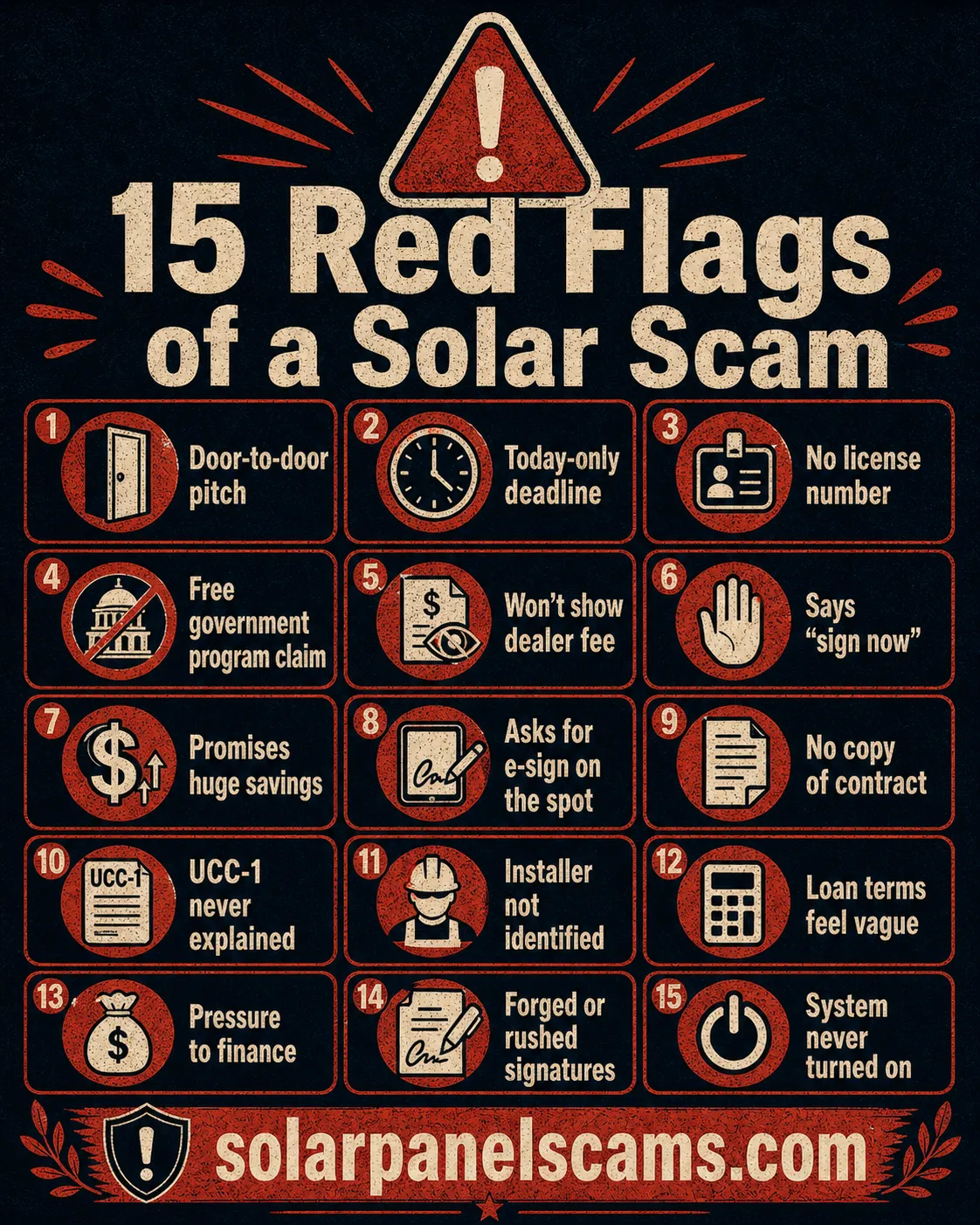
Rooftop solar remains an excellent investment for many homeowners, but the industry's growth continues to attract sophisticated fraudsters. As we enter 2026, scammers have evolved their tactics—incorporating AI-generated materials, social media targeting, and even cryptocurrency payment schemes. This updated guide covers 15 red flags that signal potential scams in today's solar market.
Solar panel scams in 2026 encompasses a new generation of deceptive practices where fraudsters deploy AI-generated sales proposals, forge official-looking government letters, demand irreversible cryptocurrency deposits, and operate interstate shell companies that vanish after harvesting deposits — making traditional consumer verification steps like license checks and BBB lookups dangerously insufficient against today's technologically amplified scams.
Use the graphic above as the fast screen and the detailed sections below as the evidence map. If you see more than one red flag, stop the signing process, save the proposal, and compare the pitch against the solar financing scams guide, the door-to-door solar scams guide, and the legal rights guide.
How Have Solar Scams Evolved in 2026?
New for 2026
| Old Tactic | 2026 Evolution | Why It's Harder to Spot |
|---|---|---|
| Generic door-to-door | AI-personalized pitches | Feels tailored and legitimate |
| Paper contracts | QR code phishing | Digital seems more official |
| Cash deposits | Crypto payments | Irreversible, untraceable |
| Local ghost companies | Interstate shell operations | Harder to track across state lines |
| Fake reviews | AI-generated testimonials | More convincing, harder to verify |
What Are the 15 Critical Red Flags?
Red Flag #1: "Act Today or Lose the Deal"
The Pressure Play
High-pressure sales remain the #1 indicator of potential scams. In 2026, tactics have become more sophisticated.
| Old Approach | 2026 Version | Your Response |
|---|---|---|
| "Sale ends today" | "AI-generated personalized deadline" | "I'll review and decide in 48 hours" |
| Government program expiring | "Exclusive community pilot program" | Verify with official sources |
| One-time discount | "Neighbor referral bonus expires" | Compare with other installers |
Why It Works
- Creates artificial urgency
- Prevents comparison shopping
- Exploits FOMO (fear of missing out)
Your Protection Legitimate solar incentives have clear, published deadlines from utilities or government agencies—not arbitrary sales deadlines. Always take 48 hours minimum to review.
If the pressure pitch sounds familiar but you cannot name the exact scam yet, match it against the solar scam pattern database. It maps repeat pitches to the evidence you should preserve and the next internal guide to read.
Red Flag #2: Verbal Promises That Vanish in Writing
The Documentation Gap
| Promise Made | What's Actually in Contract | The Disconnect |
|---|---|---|
| "$200/month savings" | No performance guarantee | Savings not contractually assured |
| "25-year warranty" | Limited equipment only | Labor, roof damage excluded |
| "Covers 100% of usage" | "Estimated production" | Actual may vary significantly |
| "No money down" | 30% dealer fee hidden | Higher total cost |
Critical Rule If it's not in the written contract, it doesn't exist. Salespeople who resist putting promises in writing are hiding something.
Red Flag #3: Confusing or Missing Permits
The Legal Operation Test
Legitimate installers handle permits professionally. Red flags include.
🚩 "You pull the permits to save money" 🚩 "We don't need permits for this size system" 🚩 Vague timeline for permission-to-operate (PTO) 🚩 No discussion of utility interconnection 🚩 Can't explain inspection process
2026 Update Some scammers now forge permit documents or provide fake inspection reports. Always verify permits directly with your local building department.
Red Flag #4: "Free" or "$0" Solar Claims
The Math Reality
There is no free solar. What "free" actually means.
| Marketing Claim | Actual Structure | True Cost |
|---|---|---|
| "Free solar panels" | 25-year lease | $30,000-$50,000 total |
| "$0 down" | High dealer fee loan | 30-40% cost inflation |
| "Government pays" | Fake program | You're paying everything |
| "No cost to you" | PPA with escalator | 86% higher by year 25 |
2026 Scam Evolution Fraudsters now use AI-generated "official government letters" to make fake programs look legitimate. Always verify at usa.gov or energy.gov.
Red Flag #5: E-Signature You Didn't Control
Digital Scam Risks
| Tactic | How It Works | Protection |
|---|---|---|
| "I'll send you the link" | Salesperson controls timing | Request documents 24 hrs in advance |
| "Sign on your tablet" | Rushed through on their device | Only sign on your own device |
| "I'll create an account for you" | They control your credentials | Create your own accounts |
| QR code at the door | Links to lookalike sites | Type URLs manually, verify SSL |
2026 Update Deepfake technology is being used to create fake video confirmations of contract acceptance. Always get written confirmation of what you're signing.
Red Flag #6: Equipment Bait-and-Switch
The Specification Game
| Promised | Delivered | Impact |
|---|---|---|
| "Premium Tier 1 panels" | Lower efficiency budget panels | 20-30% less production |
| "Enphase microinverters" | String inverters | Reduced monitoring, single point of failure |
| "25-year warranty" | 10-year equipment only | Reduced protection |
| "Latest technology" | Obsolete models | Poorer performance, harder to service |
Your Protection Contract must specify make, model, and quantity of every component. Require written change orders for any substitutions.
Run the same document through the solar contract red flag checker before signing if the equipment list, production guarantee, loan terms, lien language, or cancellation rights feel vague.
Red Flag #7: The Disappearing Installer
Service Abandonment Patterns
| Phase | Legitimate Company | Scam Operation |
|---|---|---|
| Sales | Multiple touchpoints, clear contact info | Single point of contact, vague details |
| Installation | Professional crew, permits pulled | Subcontractors, permit issues |
| Activation | Monitoring setup, PTO obtained | Delays, excuses, no monitoring |
| Service | Responsive support | Ghosted, calls unanswered |
2026 Trend "Ghost companies" now operate for 6-12 months, complete several legitimate installations to build credibility, then suddenly disappear with dozens of deposits.
Before trusting a brand on name recognition alone, check the solar company scams and scams directory for company-specific complaint guides and lender/installer patterns.
Red Flag #8: AI-Generated Proposals
The Newest Scam Tool
Fraudsters are using AI to create convincing but fake:
- Satellite imagery analysis
- Production estimates
- Utility bill projections
- Engineering diagrams
Warning Signs 🚩 Proposal looks too polished, too quickly generated 🚩 No site visit despite complex roof 🚩 Generic recommendations despite your specific situation 🚩 Shading analysis contradicts visible obstructions
Verification Request raw data sources. Legitimate companies can explain how they calculated your specific numbers.
Red Flag #9: Social Media Scams
Platform-Specific Threats
| Platform | Scam Type | Red Flag |
|---|---|---|
| Fake community solar groups | Pressure to join "exclusive" co-op | |
| Influencer "partnerships" | Unrealistic lifestyle promises | |
| TikTok | Viral "solar hack" videos | Too-good-to-be-true savings |
| Nextdoor | Neighbor recommendations | Shill accounts promoting same company |
| Fake consultant offers | Request for upfront "assessment fee" |
2026 Update Scammers create entire fake solar companies with professional websites, AI-generated team photos, and fabricated BBB profiles.
Red Flag #10: Cryptocurrency Payment Demands
The Irreversible Trap
| Claim | Reality | Risk |
|---|---|---|
| "10% discount for crypto" | No way to recover funds | Payment untraceable |
| "Blockchain-verified contract" | Meaningless techno-jargon | No legal standing |
| "Crypto-backed financing" | Not a real financial product | Likely theft |
Critical Rule Never pay for solar with cryptocurrency. Legitimate installers accept standard payment methods (check, credit card, bank transfer, financing).
Red Flag #11: Inflated System Sizing
The Oversizing Scam
| Your Usage | Recommended System | Reality |
|---|---|---|
| 8,000 kWh/year | 12 kW system | Massive oversizing |
| Limited roof space | Ground mount proposed | Unnecessary expense |
| Future EV plans | Doubled system now | Speculative, expensive |
Why It's Fraudulent Oversized systems cost more upfront and may not be permitted by utilities. Get 2-3 sizing opinions.
Red Flag #12: Fake or Inflated Reviews
Review Manipulation
| Fake Review Sign | How to Verify |
|---|---|
| All reviews from new accounts | Check reviewer history |
| Identical language across reviews | Search review phrases |
| Perfect 5-star pattern | Look for balanced feedback |
| Generic praise, no specifics | Read detailed reviews |
| Sudden influx of reviews | Check review dates |
2026 Trend AI-generated reviews are nearly indistinguishable from real ones. Look for verified purchase badges and detailed experiences.
Red Flag #13: "Exclusive" Technology Claims
Proprietary Nonsense
| Claim | Translation | Truth |
|---|---|---|
| "Patent-pending panels" | Unproven technology | No track record |
| "Exclusive partnership" | Marketing fluff | No special access |
| "Military-grade inverters" | Meaningless | Standard consumer equipment |
| "NASA-developed cells" | False authority | No such partnership |
Verification Search patent databases. If truly "patent-pending," applications are publicly visible.
Red Flag #14: Bundled Products You Don't Need
The Add-On Trap
| Product | Real Cost | Markup | Actual Value |
|---|---|---|---|
| "Critter guard" | $200 | $800-$1,200 | Minimal benefit |
| "Smart monitoring" | $0 (included) | $500-$1,500 | Standard feature |
| "Surge protection" | $150 | $800-$1,000 | Often unnecessary |
| "Extended warranty" | N/A | $2,000-$4,000 | Often redundant |
Your Protection Get line-item pricing. Research each add-on independently.
For a deeper pattern map behind these red flags, use the solar scam data library to compare scam pitches, evidence types, and next-step resources.
Red Flag #15: Vague or Missing Warranty Terms
The Coverage Gap
| Promised | Common Exclusions | What You Actually Get |
|---|---|---|
| "Comprehensive warranty" | Roof leaks, labor, shipping | Limited equipment only |
| "25-year performance" | Degradation allowances | May allow 20% loss |
| "No questions asked service" | Response time limits | 30-60 day delays |
| "Transferable to new owners" | Transfer fees, restrictions | Expensive, difficult |
Critical Questions
- Who honors the warranty if installer goes out of business?
- What's the response time for warranty claims?
- Are there any fees for warranty service?
What Should Your 2026 Verification Checklist Include?
Before Signing Anything
| Check | How to Verify | Red Flag Response |
|---|---|---|
| License active | State contractor board website | Refuses to provide number |
| Insurance valid | Certificate of insurance | Certificate has errors |
| Reviews genuine | Multiple sources, detailed | Only generic 5-star reviews |
| Equipment specified | Model numbers in contract | Vague "Tier 1" references |
| Permits understood | Can explain process | "You handle permits" |
| Warranty clear | Written terms provided | Verbal only |
| Financing transparent | Full cost disclosure | Won't explain dealer fees |
The 48-Hour Rule (Still Your Best Protection)
No legitimate solar opportunity requires same-day signing.
Use Your 48 Hours To
- Verify contractor license and insurance
- Check reviews on multiple platforms
- Get 2-3 competing quotes
- Calculate total cost including all fees
- Read the entire contract
- Consult family or advisor
If You've Spotted Red Flags
Immediate Actions
If You Haven't Signed
- Walk away
- Report to state contractor board
- Warn neighbors (if door-to-door)
If You've Signed (Within Cooling-Off Period)
- Cancel immediately (certified mail)
- Stop payment if possible
- Document everything
If Work Has Started
- Withhold final payment until complete
- Document all issues
- File complaints as needed
Reporting Resources
| Resource | Contact | Handles |
|---|---|---|
| State contractor board | State website | License violations |
| State Attorney General | Consumer protection division | Scams, deception |
| FTC | reportfraud.ftc.gov | National patterns |
| BBB | bbb.org | Mediation |
| Local police | Non-emergency line | Criminal scams |
Key Takeaways for 2026
- AI has supercharged scams: More convincing materials, harder to spot
- Social media is a new battleground: Fake reviews, influencer scams
- Crypto payments are a trap: Irreversible, untraceable
- The fundamentals haven't changed: If it sounds too good to be true, it is
- 48-hour rule remains essential: Never sign same day
- Verify independently: Don't trust company-provided information
- Document everything: Create evidence trail from day one
- Report violations: Protects you and others
Bottom Line Solar scams in 2026 uses sophisticated technology and social engineering, but the core protections remain simple: take your time, verify everything independently, and never sign under pressure.
Official Sources Behind These Red Flags
Documented red flags align with federal consumer guidance and solar-buyer resources:
- The FTC flags false government or utility affiliation, misleading "free solar" claims, unclear financing, and overstated cost savings as clean-energy scam risks: FTC solar scam guidance.
- The FTC consumer alert warns homeowners not to share personal information through unexpected ads, social messages, or forms just to "see if you qualify": FTC consumer alert on avoiding solar scams.
- The U.S. Treasury advisory lists complaint channels for solar scams and warns consumers to report businesses that do not make good on promises: Treasury consumer advisory on solar energy scams.
- The Department of Energy recommends verifying installer credentials, insurance, subcontractors, and certifications before hiring a solar installer: DOE guide to choosing a solar installer.
- If financing, credit reporting, servicing, or debt collection is part of the problem, the CFPB complaint portal explains what facts and documents to include: CFPB complaint portal.
FAQ
What is the biggest solar scam red flag in 2026?
Same-day pressure is still the biggest warning sign. AI proposals, fake reviews, and polished digital paperwork are new packaging, but the core tactic is the same: force a signature before the homeowner verifies the company, financing, and utility claims.
Are AI-generated solar proposals always scams?
No. Legitimate companies may use software to build proposals. The red flag is a proposal that looks precise but cannot be explained, sourced, or reconciled with your roof, utility bill, shading, equipment, and contract terms.
How long should I wait before signing a solar contract?
Use at least 48 hours. During that time, verify the license, compare quotes, review the financing cost, confirm utility or incentive claims, and ask for every promise in writing.
What should I watch out for to avoid scams when looking for solar panel installation services?
Watch out for unsolicited door-to-door representatives claiming your roof was "selected" for a government program, pressure to sign a digital agreement immediately, promises that you will never receive an electric bill again, and quotes that omit the exact cash price, equipment model numbers, or contractor license number. Also treat any promise of the 30% federal residential tax credit for a system installed in 2026 or later as a red flag, since that credit ended for expenditures after December 31, 2025. Finally, compare any loan against a written cash price: the CFPB says dealer fees typically run 10% to 30% of the cash price, and lease or PPA contracts may come with a UCC-1 fixture filing that can complicate a later home sale.
Related Reading
- Solar Scams: Complete Red Flags Guide
- Understanding Solar Panel Scams
- How to Report Solar Panel Scams
Last updated: 2026-10-09. Stay vigilant—scams evolve, but careful research remains your best protection.
Got blindsided by a solar deal that did not deliver?
You may have a claim — and the law may make the company that defrauded you pay your legal fees. Our 2-minute eligibility check screens for the consumer-protection statutes that apply to your situation (TILA § 130, the FTC Holder Rule, your state UDAP) and connects you with a consumer-protection attorney in our network if you qualify. Use the eligibility form to route your facts through the right intake path.
Next Research Steps
Use these resources to connect this issue with the broader solar scam pattern, the relevant legal framework, and the next practical action.
Solar panel scams
Start with the main solar panel scams guide for the broad definition and recovery roadmap.
Solar panel scams and ripoffs
Compare scam patterns, red flags, door-to-door pressure, fake rebates, and impersonation tactics.
Solar financing fraud compensation
Use this guide for loan, dealer-fee, payment-jump, PACE, lease, and lender-defense issues.
Misled by a solar company?
Free 24-hr review · Statutory fee-shifting