How to Report Solar Panel Scams: Agency Filing Guide
How to report solar panel scams to the right agencies. Complete filing guide covering the FTC, state attorneys general, and consumer protection agencies for solar scam victims.
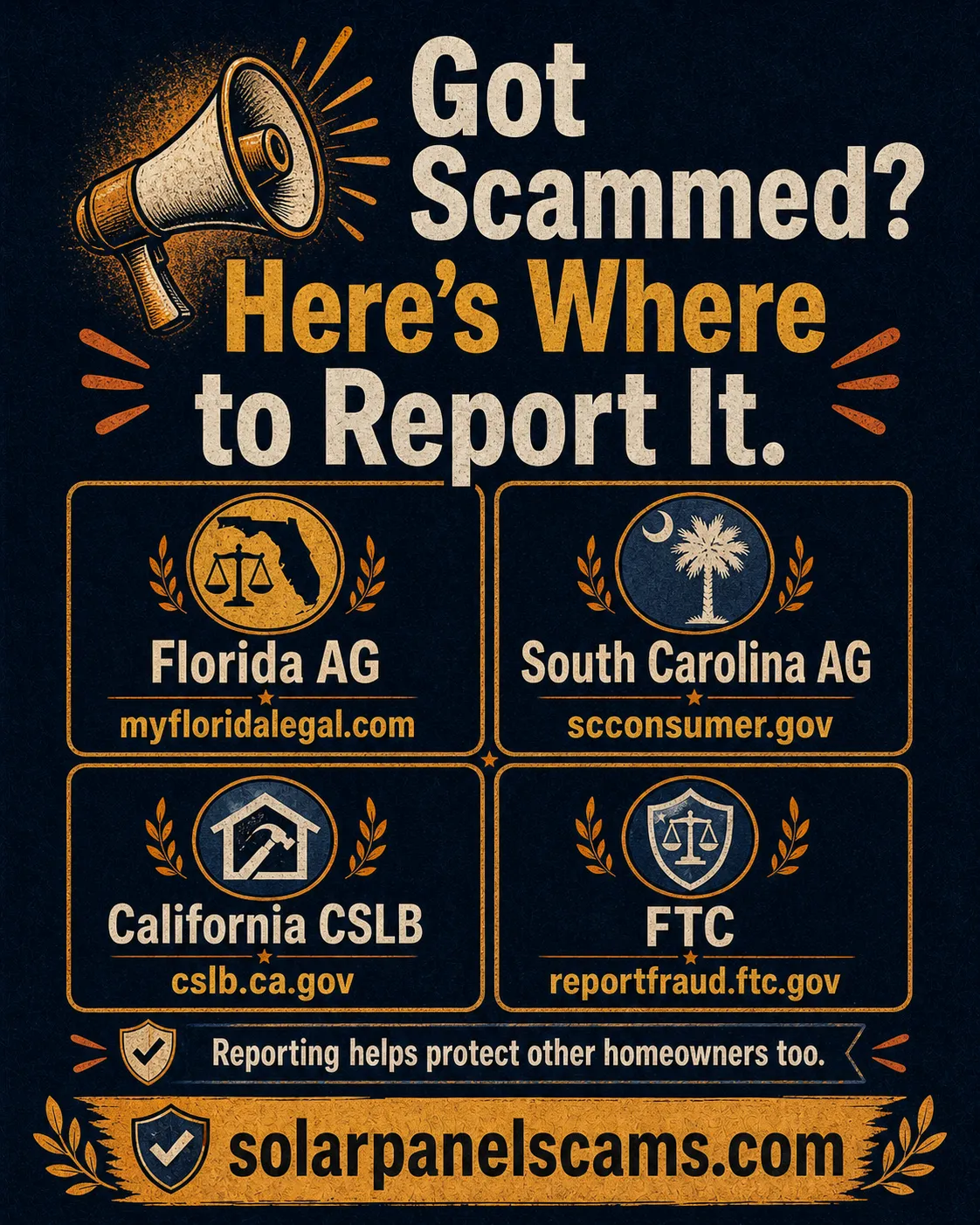
Reporting solar panel scams involve filing structured complaints with specific federal and state agencies — the FTC for deceptive trade practices, the CFPB for lending violations, your state attorney general for consumer protection claims, and your state contractor board for license violations — but individual complaints rarely trigger enforcement unless they are documented, strategically targeted, and coordinated with other victims to reveal patterns.
Every year, thousands of solar scam victims file complaints with the FTC, state attorneys general, and consumer protection agencies expecting action. Most receive automated acknowledgments and never hear another word. The system isn't broken by accident—it's structurally overwhelmed, underfunded, and designed to prioritize pattern detection over individual justice.
This investigation examines what actually happens when you report solar scams, why enforcement so rarely follows, and how savvy victims work around these institutional failures to recover their losses.
The right reporting path depends on the harm. Send deceptive sales claims and fake government-program pitches to consumer protection agencies, lending violations to the CFPB, installation or licensing issues to contractor boards, and urgent contract or lien disputes into an attorney-review path. A regulator complaint can help create a record, but if you are facing payments, collections, a UCC filing, or a closing problem, also preserve documents for the eligibility review.
How to file a solar scam complaint that gets noticed
- Match the complaint to the right agency — send deceptive sales practices to the FTC, lending violations to the CFPB, installer misconduct to your state contractor board, and state law violations to your attorney general.
- Include a complete evidence package — attach your contract, financing agreement, TILA disclosure, screenshots of marketing promises, production data, and a dated communication log; never submit a narrative-only complaint.
- Reference specific legal violations — cite the statute or regulation the company violated (TILA, state UDAP, FTC Holder Rule) rather than just describing what went wrong.
- Request a specific remedy — state exactly what you want: contract rescission, full refund, lien removal, or credit correction; generic complaints get generic responses.
- Coordinate with other victims — search Facebook groups, Reddit, and consumer forums for others targeted by the same company; 50 coordinated complaints trigger agency pattern detection far more reliably than one isolated filing.
Where Do Solar Scam Complaints Actually Go?
The Volume Problem
Federal and state agencies face an impossible math problem.
| Agency | Annual Consumer Complaints | Solar-Specific Estimates | Investigation Staff |
|---|---|---|---|
| FTC | 2.5+ million | ~5,000 | ~200 total |
| CFPB | 400,000+ | ~1,200 | ~150 total |
| State AGs (all) | 2+ million | ~8,000 | Varies widely |
| State Contractor Boards | 50,000+ | ~3,000 | Limited investigators |
The Reality With ratios of 10,000+ complaints per investigator, agencies cannot individually pursue each case. They prioritize patterns affecting hundreds or thousands of consumers—not individual disputes.
What "Investigation" Actually Means
Agency Response Patterns
| Stage | What Happens | Timeline |
|---|---|---|
| Intake | Automated acknowledgment | Immediate |
| Triage | Categorized by complaint type | 1-30 days |
| Pattern Analysis | Checked against existing investigations | 30-180 days |
| Investigation (if pattern found) | Deep dive into company practices | 6 months - 3 years |
| Enforcement Action | Settlement or litigation | 1-5 years |
| Individual Redress | Refunds to victims (rare) | Years later |
The Disconnect By the time an agency acts, individual victims have often:
- Suffered credit damage
- Paid years of fraudulent loan payments
- Missed statute of limitations
- Given up on recovery
Why Can't Agencies Help Individual Victims?
Why Agencies Can't Help Individual Victims
1. Resource Constraints
| Challenge | Impact on Victims |
|---|---|
| Limited staff | Most complaints never reviewed by humans |
| Budget limitations | Fewer than 10% of complaints trigger investigation |
| Competing priorities | Solar scam competes with identity theft, scams |
| Turnover | Experienced investigators leave for private sector |
2. Jurisdictional Fragmentation
Solar scam crosses multiple agency boundaries.
| Issue | Primary Agency | Secondary Agencies |
|---|---|---|
| Deceptive sales | FTC | State AG, local DA |
| Lending violations | CFPB | State banking regulator |
| Installation quality | State contractor board | Local building dept |
| Tax fraud | IRS | State revenue dept |
| Wire fraud | FBI | USPS Inspectors |
The Coordination Problem No single agency has full jurisdiction. Cross-referrals take months. Cases fall through cracks.
3. Burden of Proof Requirements
| Agency Standard | What It Means for Victims |
|---|---|
| FTC | Pattern of deception affecting many consumers |
| CFPB | Systemic lending violations |
| State AG | State law violations, often elderly targeting |
| Contractor Board | Clear license violations |
| Criminal (DA/FBI) | Intent to defraud, high burden |
Individual disputes rarely meet these thresholds.
Why Do Most Scam Reports Get Ignored?
The False Hope of "Filing a Complaint"
Most victims follow a predictable, futile path:
- The Standard (Ineffective) Sequence
- File FTC complaint → Auto-reply, no follow-up
- File state AG complaint → Form letter, case closed
- File BBB complaint → Company response, no resolution
- File contractor board complaint → Investigation of license (not your case)
- Call police → Told it's "civil matter"
- Give up → Years of payments continue
Time Invested 20-40 hours Recovery Rate <5%
The reasons this sequence rarely works are structural, and they are mapped in the anatomy of the solar scam surge.
Why This Approach Fails
| Flaw | Why It Doesn't Work |
|---|---|
| Isolated complaints | Don't show patterns agencies need |
| No legal pressure | Companies ignore complaints without consequences |
| No documentation | Victims fail to build evidence properly |
| Wrong agencies | Don't match complaint to appropriate enforcement |
| Passive waiting | Agencies don't prioritize individual cases |
The Alternative: Building Your Own Case
How Successful Victims Recover
The Strategy Shift
Rather than hoping agencies act, successful victims treat their case like litigation from day one—even before hiring an attorney.
Phase 1: Evidence Architecture (Weeks 1-2)
Documentation That Wins Cases
| Category | What to Collect | Why It Matters |
|---|---|---|
| Contract timeline | All versions, amendments | Shows bait-and-switch |
| Communication log | Dated record of all contacts | Establishes pattern |
| Financial trail | Every payment, fee, charge | Proves damages |
| Performance data | Production vs. promises | Documents breach |
| Competitor quotes | 2-3 other company bids | Shows market rate |
| Expert opinions | Roofer, electrician assessments | Validates damage claims |
Phase 2: Administrative Pressure (Weeks 3-4)
Strategic Complaint Filing
Rather than generic complaints, successful filers:
Match complaint to specific violations
- FTC: Deceptive trade practices
- CFPB: TILA violations, servicing errors
- State AG: State DTPA violations
- Contractor Board: License issues
Include evidence packages
- Not just narrative—attach documents
- Highlight specific regulatory violations
- Reference similar cases or patterns
Request specific remedies
- Contract rescission
- Full refund
- Credit correction
Copy legal/compliance departments
- Send complaints to company executives
- CC legal counsel
- Create internal pressure
Phase 3: Legal Leverage (Week 5+)
When to Engage an Attorney
| Situation | DIY vs. Attorney |
|---|---|
| Damages <$5,000 | Small claims court, self-represent |
| Damages $5,000-$25,000 | Consult attorney, may DIY |
| Damages >$25,000 | Attorney strongly recommended |
| Multiple legal issues | Attorney essential |
| Class action potential | Contact class action firms |
The Demand Letter Strategy
A well-crafted demand letter often achieves what complaints cannot.
| Element | Purpose |
|---|---|
| Specific legal violations cited | Shows you understand rights |
| Evidence summary | Demonstrates case strength |
| Damages calculation | Sets negotiation anchor |
| Timeline for response | Creates urgency |
| Intent to litigate | Threat of legal costs |
Success Rate with Attorney Demand Letters 30-40% achieve settlement
Inside the Enforcement System: What Actually Works
When Agencies Do Act
The Pattern Recognition Threshold
Agencies launch investigations when they see.
| Indicator | Typical Threshold |
|---|---|
| Complaint volume | 50+ similar complaints |
| Geographic spread | Multiple states affected |
| Financial impact | $1M+ consumer losses |
| Vulnerable population | Elderly/disaster victims targeted |
| Media attention | Public visibility |
| Political pressure | Legislator interest |
How to Make Your Complaint Count
Coordinate with other victims
- Facebook groups, forums
- Shared attorney
- Class action potential
Document the pattern
- Same sales pitch
- Same contract language
- Same company representatives
Contact consumer advocacy groups
- Public Citizen
- Consumer Federation
- Local news "Call for Action"
Engage elected officials
- State representative
- Congressional constituent services
- AG office directly
The Class Action Bypass
When agencies fail, collective action succeeds.
| Approach | How It Works | Timeline |
|---|---|---|
| Class action | 50+ victims, shared legal costs | 2-5 years |
| Mass joinder | Multiple plaintiffs, one case | 1-3 years |
| Coordinated individual suits | Same attorney, multiple cases | 1-2 years |
| Arbitration coordination | Same arbitrator, multiple claims | 6-12 months |
Real Recovery Stories: What Worked
Case Study 1: The Documentation Victory
Situation
- California homeowner, $45,000 system
- Promised "zero electric bill"
- Actual savings: $20/month
- Roof leak developed
Strategy
- Documented every sales promise with emails
- Hired independent solar assessor ($500)
- Got roofer report on leak cause ($300)
- Filed detailed complaint with CSLB
- Hired consumer protection attorney
Outcome
- Full contract rescission
- $47,000 recovery (system + damages)
- Attorney fees covered
- 18-month process
Key Success Factor Comprehensive documentation from day one
Case Study 2: The Collective Action Win
Situation
- Arizona retirement community
- 30+ residents targeted by same company
- Same sales pitch, same contract terms
- Systems underperforming
Strategy
- Organized victim group via Facebook
- Shared documentation showing pattern
- Approached class action attorney
- Filed coordinated AG complaints
- Media coverage (local news)
Outcome
- Class action certification
- $2.8M settlement
- Average $35,000 per victim
- 3-year process
Key Success Factor Victim coordination and pattern documentation
Case Study 3: The Small Claims Solution
Situation
- Florida homeowner, $8,000 deposit
- Company disappeared, no installation
- Police called it "civil matter"
- Too small for most attorneys
Strategy
- Filed small claims ($10,000 limit)
- Served company registered agent
- Default judgment when no appearance
- Judgment lien on company assets
- Collections via sheriff
Outcome
- Full $8,000 recovery + costs
- 6-month process
- No attorney required
Key Success Factor Appropriate venue for amount, aggressive pursuit
The Reporting Infrastructure: How to Navigate It
Agency Directory with Realistic Expectations
| Agency | What They Actually Do | Success Rate for Individual Victims |
|---|---|---|
| FTC | Pattern analysis, occasional enforcement | <5% individual recovery |
| CFPB | Lending supervision, some restitution | 10-15% for lending issues |
| State AG | Pattern cases, elder scam priority | 5-10% |
| Contractor Board | License discipline | 20-30% (helps prevent others) |
| BBB | Mediation (voluntary) | 15-20% resolution |
| Small Claims | Adjudication, enforceable judgment | 60-70% if served/awarded |
| Attorney + Demand Letter | Negotiation pressure | 30-40% settlement |
| Attorney + Litigation | Full legal process | 50-70% if case strong |
The Hybrid Strategy
Most Effective Approach
- Document thoroughly (evidence wins)
- File strategic complaints (create pressure)
- Engage attorney early (legal leverage)
- Consider small claims (fast, affordable)
- Coordinate with other victims (strength in numbers)
- Media/public pressure (corporate reputation risk)
Key Insights
- Agencies prioritize patterns, not individuals — Don't expect individual resolution from FTC/AG complaints
- Documentation is everything — The victim with photos, emails, and records wins
- Legal pressure works — Demand letters from attorneys achieve what complaints cannot
- Small claims is underutilized — Fast, affordable, effective for <$10,000 cases
- Coordination multiplies impact — 50 complaints = pattern; 1 complaint = ignored
- Speed matters — Statutes of limitations, evidence preservation, company viability
- The system is designed for compliance, not justice — Work around it strategically
Bottom Line The solar scam reporting system is structurally incapable of delivering individual justice. Victims who recover treat their cases like litigation from day one, build comprehensive evidence, apply legal pressure directly, and coordinate with others when possible. Don't file complaints and hope—build your case and fight.
Official Filing Links
Use official intake portals and keep a copy of every submission:
- File deceptive sales, fake government-program, impersonation, or clean-energy scam reports with the FTC: ReportFraud.ftc.gov.
- File solar loan, servicing, credit reporting, debt collection, or other financial-product complaints with the CFPB: CFPB complaint portal.
- Find your state attorney general for state consumer-protection complaints: National Association of Attorneys General directory.
- If the issue involves elder financial exploitation, the CFPB points consumers to local law enforcement, state attorneys general, adult protective services, and the FTC: CFPB complaint guidance for scams.
- The Treasury's solar scam advisory also directs consumers to the FTC, CFPB, state consumer agencies, and local authorities depending on the harm: Treasury consumer advisory on solar energy scams.
Related Investigation
- Solar Scam Crisis: Industry Analysis
- Homeowners Legal Rights Against Solar Scams
- Solar Panel Financing Scam Compensation
FAQ
Where should I report solar panel scam first?
Start with the agency that matches the misconduct. Use the FTC for deceptive sales practices, the CFPB for loan or servicing problems, your state attorney general for state consumer protection violations, and your contractor board for licensing or installation misconduct.
What should I include in a solar scam complaint?
Attach the contract, financing documents, sales proposal, utility bills, screenshots of promises, production data, payment records, and a dated communication log. A documented evidence package is far stronger than a short narrative complaint.
Will filing a complaint get my money back?
Usually not by itself. Complaints help agencies identify patterns, but individual recovery often requires a demand letter, small claims case, arbitration, litigation, lender dispute, or coordinated action with other victims.
Need Strategic Help?
Start the eligibility review for guidance on building your evidence, selecting the right legal strategy, and coordinating with other victims.
Last updated: 2026-06-20. Based on analysis of FTC complaint data, CFPB enforcement actions, state AG annual reports, and interviews with consumer protection attorneys.
Next Research Steps
Use these resources to connect this issue with the broader solar scam pattern, the relevant legal framework, and the next practical action.
Solar panel scams
Start with the main solar panel scams guide for the broad definition and recovery roadmap.
Report solar fraud
Build a complaint packet for the FTC, CFPB, state attorney general, licensing board, or counsel.
Solar panel scams and ripoffs
Compare scam patterns, red flags, door-to-door pressure, fake rebates, and impersonation tactics.
Homeowner legal rights
Review cancellation, rescission, UDAP, TILA, Holder Rule, arbitration, and lawsuit options.
Misled by a solar company?
Free 24-hr review · Statutory fee-shifting