Titan Solar 30-Year Warranty After Bankruptcy: GoodLeap & Mosaic Rights [Dispute Guide]
Titan Solar promised 30 years of free repairs before Chapter 7 liquidation. Discover how GoodLeap and Mosaic borrowers can enforce the FTC Holder Rule.
Disclaimer This article is for consumer informational and educational purposes only and does not constitute formal legal advice. For advice regarding individual arbitration, debt cancellation, or contract litigation, consult a licensed consumer protection attorney.
Overview
Before its sudden shutdown on June 13, 2024, and subsequent Chapter 7 bankruptcy liquidation in the U.S. Bankruptcy Court for the District of Arizona, Titan Solar Power was one of the largest residential solar installers in the United States, having placed rooftop arrays on over 150,000 households across Arizona, California, Texas, Florida, and Nevada.
               TITAN SOLAR COLLAPSE & THE GOODLEAP ARBITRATION PRECEDENT

       [Titan Solar Power: Mesa, AZ] ───> [150,000 Households Stranded]
          (Chapter 7 June 2024)             ("30-Year Free Repairs" Dead)
                    │                                     │
                    ▼                                     ▼
        [Lender: GoodLeap / Loanpal] ───> ["Loan is Separate Contract" Defense]
        (Holds $40k-$70k Promissory Note)         (Demands Ongoing Payments)
                    │
                    ▼
       [Landmark July 29, 2024 Ruling] ─> [Former GA Supreme Court Chief Justice]
        • $90,000 GoodLeap Note Wiped Out  • Installer Acted as Lender's Agent
        • $13,000 Damages + Legal Fees    • Enforced Under FTC Holder Rule
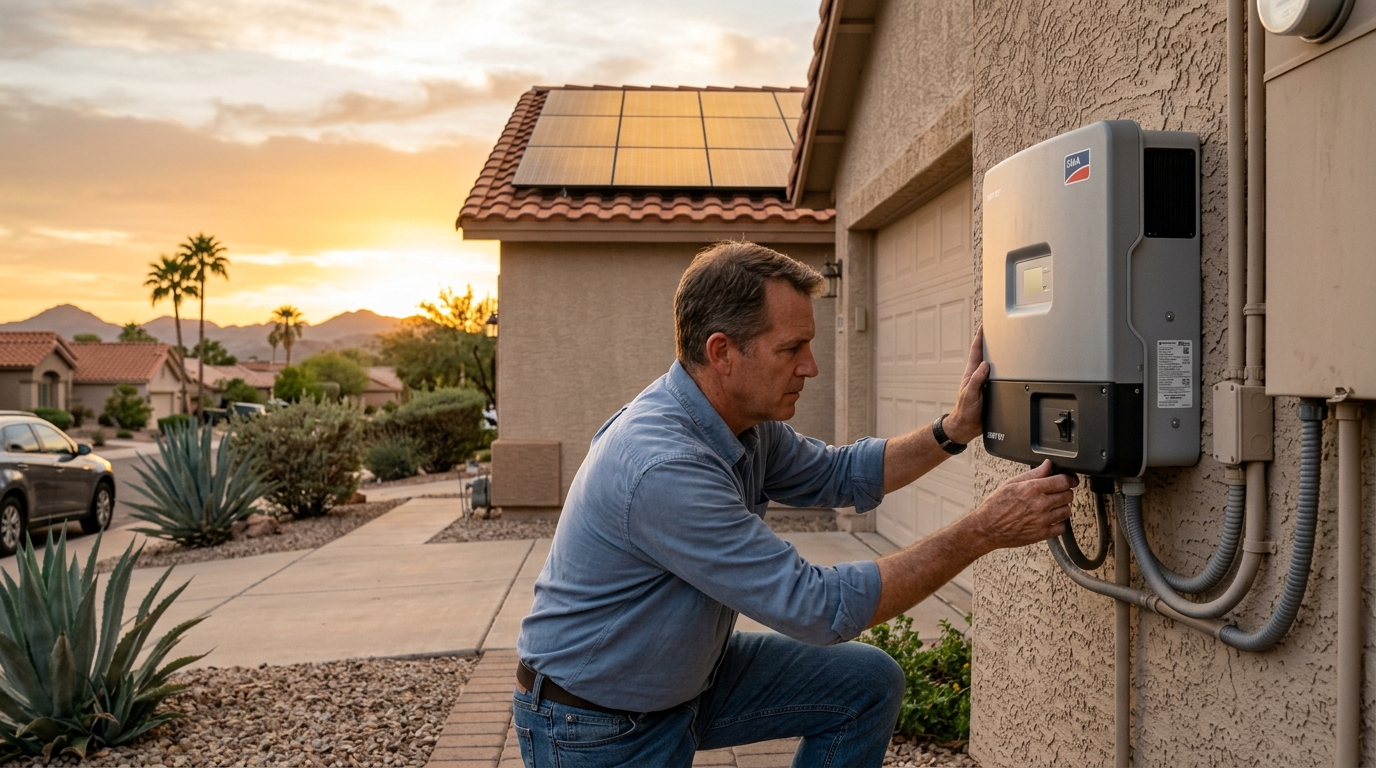
The core hook of Titan's aggressive sales pitch was a "30-year bumper-to-bumper warranty" guaranteeing free repairs, monitoring, roof penetration protection, and lifetime inverter replacements. Today, thousands of Titan customers are experiencing standard inverter failures (typically occurring between years two and four on SolarEdge and Enphase systems), only to discover that Titan's corporate entity is dissolved. (Read our analysis on when both installer and lender go bankrupt: who do you owe?).
When homeowners contact their financing company—predominantly GoodLeap (formerly Loanpal) or Solar Mosaic—they are met with a rigid corporate wall: "Your loan is an independent contract. You must continue paying your $250/month bill even if your panels produce zero power."
However, federal consumer credit regulations and binding arbitration precedents tell a very different story under the federal FTC Holder Rule.
Key Takeaways
- The Chapter 7 Reality Titan Solar Power is liquidated. There are no corporate assets or warranty reserves to repair equipment or reimburse failed inverters.
- The "Separate Contract" Defense Fails GoodLeap's argument that the financing agreement is insulated from Titan's collapse is superseded by the federal FTC Holder Rule (16 CFR Part 433).
- The Landmark Arbitration Ruling On July 29, 2024, a binding arbitration award issued by a former Chief Justice of the Georgia Supreme Court completely cancelled a borrower's $90,000 GoodLeap loan, awarded $13,000 in damages, and established that the failed installer acted as GoodLeap's agent.
- Manufacturer RMA vs. Lender Liability While homeowners can obtain free hardware replacements directly from Enphase or SolarEdge, the out-of-pocket costs for third-party labor and lost energy production should be asserted directly against GoodLeap or Mosaic to offset your loan balance. (See third-party solar warranty and orphaned system options).
The Broken Promise: "30 Years of Free Inverter Replacements"
Inverters are the mechanical heart of a solar array, converting Direct Current (DC) power from panels into Alternating Current (AC) power for your home. While tier-1 solar panels can produce power for 25 years, residential solar inverters have an industry failure rate of 15% to 25% within the first five years.
Titan’s door-to-door reps routinely assured homeowners:
- "If an inverter fails, a Titan technician will be at your house within 48 hours to replace it at zero cost."
- "You never have to pay a single dollar for maintenance or monitoring."
- "Your energy savings will always exceed the loan payment."
When Titan liquidated in June 2024, that service infrastructure evaporated overnight. When an inverter displays a solid red light or an error code (such as Isolation Fault or Grid Disconnect), local independent solar electricians charge $1,500 to $3,500 in diagnostic and replacement labor to swap the unit.
Borrowers are left paying out-of-pocket repair costs while simultaneously servicing a $40,000 to $70,000 GoodLeap promissory note.
The Landmark July 29, 2024 Arbitration Award Against GoodLeap
For years, GoodLeap has inserted mandatory individual-arbitration clauses and class-action waivers into its promissory notes, forcing aggrieved borrowers into private arbitration before the American Arbitration Association (AAA) or JAMS.
That strategy backfired dramatically in a landmark decision issued on July 29, 2024.
In an individual arbitration proceeding presided over by an arbitrator who previously served as Chief Justice of the Georgia Supreme Court:
- $90,000 Loan Fully Cancelled The arbitrator ordered the complete rescission and cancellation of the homeowner's $90,000 GoodLeap solar promissory note.
- Damages and Attorney Fees Awarded GoodLeap was ordered to pay approximately $13,000 in damages, plus full reimbursement of the homeowner's legal costs.
- Agency Finding Crucially, the arbitrator determined that the failed sales and installation partner had acted as GoodLeap’s legal agent, rejecting GoodLeap’s contention that it was a passive, uninvolved third party.
- FTC Holder Rule Enforcement The award affirmed that under 16 CFR Part 433, all claims and defenses arising from the installer's deceptive representations and unfulfilled warranties attach directly to the loan in GoodLeap's hands.
This award established a powerful legal blueprint for thousands of stranded Titan Solar borrowers nationwide.
Direct Manufacturer Warranty Bypass: How to Fix Hardware Now
Do not wait months in dispute to get your power restored. You can separate the hardware replacement from the financial fight.
1. SolarEdge Inverters and Optimizers
If your system uses a central SolarEdge inverter:
- Note the serial number on the side of the unit (begins with
SJorSN). - Contact SolarEdge Technical Support directly or submit a ticket through the SolarEdge portal.
- SolarEdge covers the hardware replacement under its 12-to-25-year manufacturer warranty. They will ship a replacement inverter directly to you or an approved independent contractor.
2. Enphase Energy Microinverters
If your system has individual Enphase microinverters under each panel:
- Open your Enphase Enlighten monitoring app to identify failing microinverters (shown in black or orange).
- Submit a warranty claim through the Enphase Owner portal.
- Enphase provides direct Return Merchandise Authorization (RMA) replacements.
Crucial Step Keep all invoices, electrician receipts, and truck-roll fees for installing the replacement hardware. These expenses constitute out-of-pocket damages that you will assert against GoodLeap or Mosaic under the Holder Rule.
Step-by-Step Dispute & Arbitration Path Against GoodLeap
If GoodLeap or Mosaic refuses to adjust your loan balance to reflect the destroyed 30-year warranty, take these formal steps.
  STEP 1: Document Failure & Out-of-Pocket Costs
    └── Gather utility true-ups, inverter error logs, and electrician repair quotes.
         │
  STEP 2: Issue Formal FTC Holder Rule Notice of Dispute
    └── Demand loan re-amortization, warranty offset, and credit protection under FCRA.
         │
  STEP 3: File CFPB & State Attorney General Complaints
    └── Submit formal complaints to CFPB and your State AG Consumer Protection Division.
         │
  STEP 4: File Demand for Individual Arbitration (AAA / JAMS)
    └── Invoke the mandatory arbitration clause; GoodLeap must pay major filing fees.
1. Document the Breach
Calculate the total economic impact:
- Number of months the system has produced zero or reduced kilowatt-hours.
- Total "dual bills" paid to your electric utility during the downtime.
- Invoices for third-party diagnostic and inverter replacement labor.
- The lost value of Titan's defunct 30-year workmanship and roof penetration warranty.
2. Serve a Formal Notice of Dispute
Send a written dispute via Certified Mail to GoodLeap's legal and escalations department. Specifically cite:
- Titan Solar Power's Chapter 7 bankruptcy liquidation in Arizona.
- Total failure of consideration and breach of the integrated warranty.
- Preservation of claims under 16 CFR § 433.2.
- Demand for debt reduction and immediate waiver of interest accrued during system downtime.
3. Initiate Individual Consumer Arbitration
If GoodLeap refuses to provide a reasonable settlement, file a demand for arbitration with the American Arbitration Association (AAA) under the Consumer Arbitration Rules:
- Under standard consumer arbitration clauses, the consumer filing fee is capped at $200 (or $250 for JAMS).
- GoodLeap is legally required to pay all remaining arbitrator fees and administration expenses, which routinely exceed $5,000 to $10,000 per case.
- Faced with substantial non-refundable forum fees and the precedent of the July 2024 Georgia ruling, lenders frequently agree to loan cancellations or significant balance write-downs.
Sources and Official References
- U.S. Bankruptcy Court, District of Arizona: In re Titan Solar Power, Inc. (Chapter 7 Docket)
- Federal Trade Commission: The Holder Rule (16 CFR Part 433)
- Consumer Financial Protection Bureau: Issue Spotlight on Solar Financing
- American Arbitration Association: Consumer Arbitration Rules and Fee Schedules
- Cornell Law LII: Uniform Commercial Code § 9-513 (Termination Statement)
FAQ
Can my loan be forgiven because Titan Solar went bankrupt?
While bankruptcy does not automatically erase your promissory note on its own, you can seek loan forgiveness or substantial cancellation by asserting the FTC Holder Rule (16 CFR Part 433). Because Titan breached its fundamental installation and warranty obligations, federal law permits you to assert that breach against GoodLeap or Mosaic to demand contract rescission, offset of out-of-pocket repair costs, and balance reductions.
Who pays to replace my broken Titan Solar inverter?
Titan Solar Power will not pay because the company is in Chapter 7 liquidation. However, the physical inverter is covered by the manufacturer's warranty (typically 12 to 25 years from SolarEdge or Enphase). You can obtain replacement equipment from the manufacturer, hire an independent electrician to perform the labor, and assert those labor costs against your solar lender under the Holder Rule.
What did the Georgia Supreme Court Chief Justice rule regarding GoodLeap?
In a landmark binding arbitration award issued on July 29, 2024, a former Chief Justice of the Georgia Supreme Court ruled that a defunct installer acted as GoodLeap's agent in consumer sales. The arbitrator ordered the complete cancellation of the homeowner's $90,000 GoodLeap loan, awarded $13,000 in damages, and ordered GoodLeap to pay the borrower's legal fees under the FTC Holder Rule.
Does the FTC Holder Rule apply to my Titan Solar GoodLeap loan?
Yes. Every consumer solar loan originated by GoodLeap, Mosaic, or Sunlight Financial contains a mandatory FTC Holder Rule clause. This clause explicitly makes the lender subject to all legal claims and defenses that you could have asserted against Titan Solar Power.
How much does it cost to take GoodLeap to arbitration?
Under the consumer arbitration provisions in GoodLeap contracts, consumer filing fees with the American Arbitration Association (AAA) are capped at approximately $200. GoodLeap is contractually and legally obligated to pay the rest of the arbitration costs, which can range from $4,000 to $12,000. This fee structure provides significant leverage for consumers seeking loan cancellation.
Next Research Steps
Use these resources to connect this issue with the broader solar scam pattern, the relevant legal framework, and the next practical action.
Solar panel scams
Start with the main solar panel scams guide for the broad definition and recovery roadmap.
Solar company complaint directory
Look up installers, lenders, bankruptcies, warranty problems, and customer-service complaint patterns.
Solar financing fraud compensation
Use this guide for loan, dealer-fee, payment-jump, PACE, lease, and lender-defense issues.
Homeowner legal rights
Review cancellation, rescission, UDAP, TILA, Holder Rule, arbitration, and lawsuit options.
Trapped in a predatory loan?
FTC Holder Rule & cancellation rights