Sunlight Financial Payment Jump at Month 19: The Solar Tax Credit Trap Explained
Why Sunlight Financial solar loan payments suddenly spike at Month 19, how the 30% tax credit trap works, and legal options under TILA to challenge dealer fees.
Disclaimer: This article provides financial analysis and consumer-protection information regarding residential solar financing agreements. It does not constitute formal tax or legal advice. Consult a certified public accountant (CPA) or consumer attorney regarding your specific tax liability and contract terms.
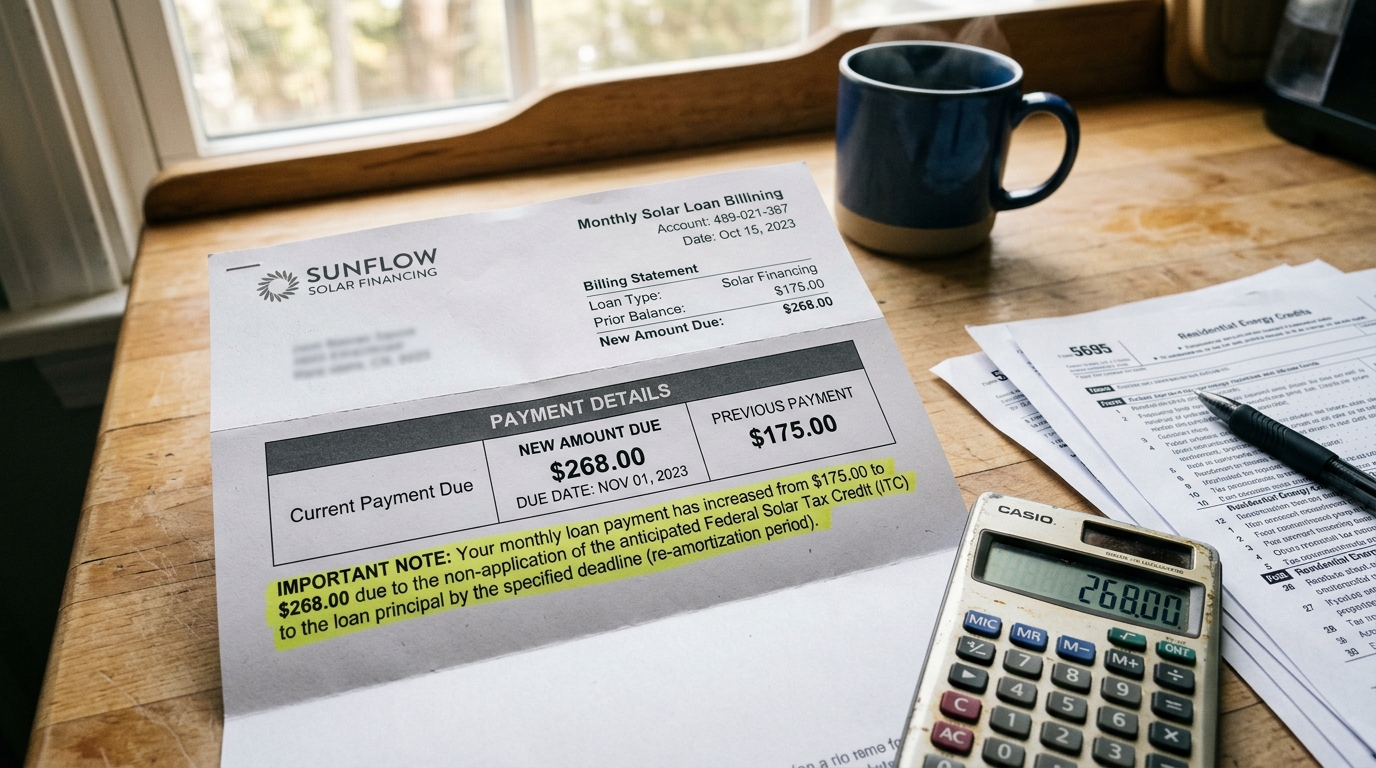
Direct Answer Your Sunlight Financial monthly payment jumped at Month 19 because the loan was structured with an artificial 18-month "introductory" teaser payment. Sunlight’s promissory note requires borrowers to remit a lump-sum prepayment equal to the 30% federal solar tax credit before Month 18. If you were retired, had low taxable income, or did not qualify to receive the full cash value from the IRS, Sunlight automatically re-amortizes the remaining balance over the final 23.5 years, causing monthly payments to skyrocket by 35% to 55%.
The Month 19 Shock: "They Promised My Payment Was Fixed for 25 Years"
On solar discussion forums and regulatory complaint boards across the country, a recurring grievance appears every single month.
"I signed up for a Sunlight Financial loan at $175 a month. The sales rep swore solar would replace my electric bill and my payment would never increase for 25 years. But on my Month 19 statement, my payment suddenly jumped to $285 a month! Now I’m paying Sunlight more than my original power bill, plus a monthly utility connection charge. How is this legal?"
It is legal only if the lender complied strictly with the federal Truth in Lending Act (TILA) and state consumer fraud disclosures. In thousands of documented cases, lenders and their partner installers crossed the line into deceptive lending.
Case Scenario: The Florida Retirement Tax Trap
A retired couple in Florida agreed to a $52,000 Sunlight Financial solar loan financed through Cross River Bank. The door-to-door representative promised that their monthly payment would be locked at $185/month, easily beating their historical $240/month electric bill.
The representative assured them: "The federal government will send you a $15,600 rebate check for going green. You just forward that check to Sunlight to keep everything on schedule."
The Trap: The federal residential clean energy credit (Internal Revenue Code § 25D) is a non-refundable tax credit, not a cash rebate check. Because the retired couple lived primarily on tax-exempt Social Security benefits, their total federal income tax liability was only $2,000 per year. They could not monetize the $15,600 credit.
When Month 18 arrived without a $15,600 lump-sum payment, Sunlight triggered its automatic re-amortization clause. At Month 19, their payment spiked to $315/month—substantially higher than the utility bill they were trying to eliminate.
How the 18-Month Teaser Structure Actually Works
To make expensive solar systems appear affordable on a kitchen-table sales pitch, lenders like Sunlight Financial, GoodLeap, and Mosaic engineered a two-stage amortization structure.
graph TD
    A[Total Loan Amount: $50,000] --> B[Months 1 to 18: Teaser Amortization]
    B -->|Artificially assumes you will pay $15,000 lump sum| C["Teaser Payment: $175/Month"]

    C --> D{Month 18 Payment Deadline}
    D -->|Option A: Pay $15,000 Cash to Lender| E["Payment Remains at $175/Month"]
    D -->|Option B: Did Not Receive or Remit $15,000| F["Automatic Re-Amortization Triggered"]

    F --> G["Months 19 to 300: Payment Spikes to $285/Month (+62%)"]
The Math Behind the Spike:
- The Artificial Baseline: The initial 18 monthly payments are calculated as if the principal balance was only 70% of the loan amount from Day 1.
- The Balloon Re-Calculation: If the borrower does not pay the 30% "tax credit balloon" before the 18th payment cycle, the lender re-calculates the monthly payment using the full unreduced principal balance across the remaining 282 months.
- Compound Interest Harm: Because the borrower was underpaying principal during the first 18 months, the remaining debt has accumulated interest, resulting in an even higher lifetime finance charge.
The Second Hidden Trap: 15% to 35% Disguised "Dealer Fees"
The payment jump at Month 19 is exacerbated by a second deceptive financing mechanism: concealed dealer fees.
When salespeople offer enticing low-interest financing—such as "1.99% or 2.99% fixed APR"—they rarely disclose that the lender adds a massive upfront fee to the cash price of the system.
The Minnesota Attorney General's $35 Million Lawsuit
In March 2024, Minnesota Attorney General Keith Ellison filed a landmark enforcement action against Sunlight Financial, GoodLeap, Solar Mosaic, and Dividend Solar Finance. The state’s complaint alleged that these lenders engaged in an unlawful, deceptive scheme that cost Minnesota homeowners over $35 million in undisclosed dealer fees:
- The Cash vs. Financed Gap: A solar system with a cash price of $30,000 was routinely marked up to $40,000 or $45,000 when financed through Sunlight Financial.
- Contractual Concealment: The Attorney General uncovered confidential dealer agreements in which Sunlight explicitly prohibited partner installers from disclosing the dealer fee to the consumer. Installers were barred from itemizing the fee or explaining why the financed price was tens of thousands of dollars higher than the cash price.
- Deceptive Usury Violations: By disguising interest as an inflated upfront principal fee, the state alleged that lenders deceived borrowers about the true Annual Percentage Rate (APR) and violated state usury caps.
| Loan Component | Transparent Cash Price | Sunlight Financed Package | Deceptive Consumer Harm |
|---|---|---|---|
| Actual Hardware & Labor | $32,000 | $32,000 | Baseline system value |
| Hidden Dealer Fee (28%) | $0 | $8,960 | Inflated principal balance |
| Total Financed Principal | $32,000 | $40,960 | Homeowner borrows $8,960 more |
| Month 1–18 Payment (Teaser) | N/A | $155 / month | Based on 70% of $40,960 |
| Required Month 18 Lump Sum | N/A | $12,288 | Inflated by dealer fee |
| Month 19+ Payment Spike | N/A | $248 / month | +60% monthly increase |
Legal Remedies: How Homeowners Can Fight Month 19 Payment Increases
Homeowners caught in the Month 19 payment spike are not without legal recourse. Consumer attorneys have successfully challenged these loan structures under federal and state statutes.
1. Truth in Lending Act (TILA) Violations (15 U.S.C. § 1601 et seq.)
TILA requires lenders to clearly and conspicuously disclose the Annual Percentage Rate, the schedule of payments, and the total finance charge. Under 15 U.S.C. § 1605, any charge payable directly or indirectly by the consumer and imposed directly or indirectly by the creditor as an incident to the extension of credit must be included in the finance charge. By rolling dealer fees into the amount financed rather than disclosing them as a finance charge, lenders violate federal disclosure requirements, entitling consumers to statutory damages and fee-shifting.
2. State Deceptive Trade Practices Acts (UDAP / DTPA)
Sales reps who told retired, fixed-income, or disabled homeowners that they would receive a "guaranteed government check" committed actionable fraud. In states like California (CLRA), Florida (FDUTPA), Texas (DTPA), and New Jersey (CFA), misrepresenting tax credits to consumers who cannot qualify constitutes deceptive marketing, exposing both the installer and the financing platform to claims for rescission and treble damages.
3. Substantive Loan Modification & Dealer Fee Recoupment
Through formal demand letters or individual American Arbitration Association (AAA) filings, borrowers have obtained substantial loan modifications:
- Forcing Sunlight to credit the hidden dealer fee back against the outstanding principal balance.
- Freezing monthly payments at the original teaser rate for the full duration of the loan.
- Canceling the debt entirely where the sales rep committed fraud in the factum or forged digital signatures.
Verbatim Dispute Template: TILA § 130 Notice of Undisclosed Finance Charge & Dealer Fee Demand
Copy and submit via USPS Certified Mail to Sunlight's Lending Compliance Division.
[Date]

VIA CERTIFIED MAIL — RETURN RECEIPT REQUESTED
To: Sunlight Financial LLC / Legal Compliance & Executive Grievance
    [Servicing Address Listed on Monthly Statement]
Copy: Cross River Bank / Regulatory Compliance Desk
      885 Teaneck Road, Teaneck, NJ 07666

RE: NOTICE OF TRUTH IN LENDING ACT (TILA) DISCLOSURE VIOLATIONS (15 U.S.C. § 1605)
    DEMAND FOR PRINCIPAL REDUCTION & TEASER PAYMENT REFORMATION
    Borrower Name: [Your Full Name]
    Co-Borrower (if applicable): [Co-Borrower Name]
    Property Address: [Your Property Address]
    Loan Account #: [Loan Account Number]
    Installer Entity: [Name of Solar Contractor]

Dear Compliance and Lending Review Desk.

I am writing to formally dispute the calculation of the Amount Financed, Finance Charge, and Payment Schedule on consumer credit contract #[Loan Account #] originated through Sunlight Financial LLC and funded by Cross River Bank.

1. DECEPTIVE DEALER FEE CONCEALMENT.
A forensic review of the transaction reveals that the cash contract price quoted by the installer was $[Cash Price], whereas the principal amount financed on the Sunlight loan disclosure was $[Financed Amount].
The difference of $[Dollar Difference] represents an undisclosed "dealer fee" or financing origination premium imposed by Sunlight Financial on the transaction.

Under 15 U.S.C. § 1605(a) and 12 C.F.R. § 1026.4(a), any charge payable directly or indirectly by the consumer and imposed directly or indirectly by the creditor as an incident to or a condition of the extension of credit is a FINANCE CHARGE. By embedding this fee directly into the principal "Amount Financed," Sunlight Financial misstated the Annual Percentage Rate (APR) and understated the true finance charge, in direct violation of federal Truth in Lending Act requirements and state usury limitations (see State of Minnesota v. Sunlight Financial et al., Hennepin Cty. Dist. Ct.).

2. DECEPTIVE TAX CREDIT RE-AMORTIZATION.
The sales agent acting on behalf of Sunlight Financial affirmatively represented that the monthly payment would remain locked at $[Teaser Payment Amount] for the 25-year life of the loan, assuring me that "federal tax incentives would cover the difference." The sales agent failed to disclose that Internal Revenue Code § 25D is a non-refundable tax credit requiring adequate taxable income, and obscured the contract provision mandating a sudden payment spike at Month 19.

FORMAL SETTLEMENT DEMAND.
To resolve these statutory disclosure violations without the necessity of initiating formal arbitration before the American Arbitration Association (AAA) pursuant to 15 U.S.C. § 1640:
1. Credit the entire undisclosed dealer fee markup of $[Dollar Difference] against the outstanding loan principal;
2. Reform the payment schedule to lock the monthly installment at the original teaser rate of $[Teaser Payment Amount] per month for the remaining loan term; and
3. Provide an updated, accurate Truth in Lending disclosure statement reflecting the corrected amortization.

Please provide a formal written response within twenty (20) calendar days of receipt.

Sincerely,

_________________________________________
[Your Signature]
[Your Printed Legal Name]
[Your Phone Number]
[Your Mailing Address]
FAQ
Can I sue Sunlight Financial for deceptive tax credit advice?
While Sunlight Financial frequently includes disclaimers stating they do not provide tax advice, sales representatives operating on their behalf routinely misled consumers. Under the federal FTC Holder Rule (16 C.F.R. § 433.2), you can assert the sales rep's deceptive misrepresentations against Sunlight Financial to demand contract reformation or rescission.
What happens if I can't afford the Month 19 payment increase?
Do not simply default or ignore the billing statements. Contact consumer legal counsel to review your original TILA disclosure box and sales proposals. You can submit a formal notice of dispute under the Fair Credit Reporting Act while exploring loan modification or arbitration options.
How do I find out how much my dealer fee was?
Compare the cash contract price quoted by your installer against the "Amount Financed" line on page 1 or 2 of your Sunlight Financial promissory note. The mathematical difference between those two numbers represents the dealer fee and origination charges added to your principal.
Does the solar tax credit roll over if I couldn't use it in Year 1?
Yes. Under IRC § 25D, unused federal residential clean energy credits can carry forward to future tax years. However, carrying forward $1,000/year over a decade does not solve your immediate Month 18 deadline with Sunlight Financial, which demands the full lump-sum upfront.
Sources
- Internal Revenue Service: Residential Clean Energy Credit (Section 25D), IRS Fact Sheet FS-2024-15.
- Minnesota Attorney General Keith Ellison: State of Minnesota v. GoodLeap, Sunlight Financial, Cross River Bank et al., MN Attorney General Announcement.
- Federal Trade Commission: Truth in Lending Act Regulations (Regulation Z), 12 C.F.R. Part 1026, Consumer Financial Protection Bureau.
- National Consumer Law Center (NCLC): Solar Lending Traps: Dealer Fees, Balloon Amortizations, and Deceptive Sales, NCLC Consumer Publications.
- U.S. Court of Appeals for the Third Circuit: Consumer Credit Disclosure Standards in Financed Home Improvements, 15 U.S.C. § 1640.
Next Research Steps
Use these resources to connect this issue with the broader solar scam pattern, the relevant legal framework, and the next practical action.
Solar panel scams
Start with the main solar panel scams guide for the broad definition and recovery roadmap.
Solar financing fraud compensation
Use this guide for loan, dealer-fee, payment-jump, PACE, lease, and lender-defense issues.
Homeowner legal rights
Review cancellation, rescission, UDAP, TILA, Holder Rule, arbitration, and lawsuit options.
Trapped in a predatory loan?
FTC Holder Rule & cancellation rights