Solar Company Says Your Roof Leak Photos Aren't Enough Proof? [Evidence Checklist]
Solar installer denying your roof leak warranty claim? Here is the exact forensic evidence checklist, attic inspection protocol, and legal leverage needed.
Disclaimer This article is for consumer educational and informational purposes only and does not constitute formal engineering, roofing, or legal advice. If you have active structural damage or electrical hazards near water, immediately turn off relevant breakers and consult a licensed roofing contractor and structural engineer.
Overview
A devastatingly common script plays out whenever heavy rains hit homes with rooftop solar installations.
"Water began pouring through my living room ceiling six months after installation. The solar installer came out once, slapped caulk around a few brackets, and promised it was fixed. Next rainstorm, the ceiling collapsed. When I submitted clear photos of the stained drywall and the wet roof mounts, the warranty claims department responded: 'Cell phone photos of drywall stains do not prove our penetrations caused the leak. It could be pre-existing roof wear or an unsealed plumbing vent. Claim denied.' What evidence do I actually need to make them pay?"
              THE SOLAR ROOF LEAK EVIDENCE GAP

   [What Homeowners Submit]             [Why Companies Deny It]
   • Smartphone ceiling stain photo ──> • "Drywall stains don't prove origin"
   • Ground-level photo of panels   ──> • "Could be unrelated vent/valley"
   • Text message history           ──> • "Not a licensed engineering report"
                    │                                    │
                    ▼                                    ▼
       ┌────────────────────────────────────────────────────────┐
       │   THE UNBEATABLE FORENSIC ROOF LEAK DOSSIER           │
       │                                                        │
       │ 1. Attic "Shiner" Photos (Lag bolts missing rafters)   │
       │ 2. Thermal Imaging (FLIR moisture mapping)             │
       │ 3. Moisture Meter Readings (Pin WME % > 20% active)    │
       │ 4. Licensed C-39 Roofer Forensic Causation Affidavit   │
       │ 5. Prior "Resealing" Work Order (Admission of defect)  │
       └────────────────────────────────────────────────────────┘
                    │                                    │
                    ▼                                    ▼
   [State Contractor Board Complaint]    [FTC Holder Rule Lender Dispute]
   • Cal. BPC § 7109 / Fla. § 489.129     • 16 C.F.R. § 433.2 Loan Offsets
   • Contractor Surety Bond Demand        • Commercial Liability Policy Claim
Solar companies and their third-party warranty administrators rely on the "Evidence Gap" to brush off tens of thousands of dollars in water damage claims. By setting an impossibly vague standard of "acceptable proof," they stall until the homeowner gives up or pays out-of-pocket for emergency repairs—destroying the physical evidence in the process.
To overcome this stonewalling, you must build an unassailable forensic evidence package that eliminates their standard excuses under state contractor licensing rules and commercial warranty law. (Review our practical guide on who pays to remove solar panels for roof repair and insurance claims for solar roof damage).
Key Takeaways
- Why Cell Phone Photos Get Denied Photos taken from the ground or inside a living room demonstrate damage, but they fail to prove causation. Installers blame pre-existing underlayment decay, unrelated roof valleys, or plumbing pipe boots. (See our guide on attic mold after solar panel installation).
- The "Resealing" Trap When an installer sends a technician to "reseal" a leaking mount with silicone mastic without unbolting the array, they are applying a temporary band-aid. Keep that service receipt: a prior service visit for roof leaks is powerful legal evidence of notice and an admission of a defect under the solar warranty claims process.
- The Critical Attic Inspection The most decisive evidence lives in the attic directly beneath the solar array. Photos of "shiners"—lag bolts driven through the roof deck that missed the wooden rafters—provide definitive proof of improper contractor workmanship.
- The Independent Roofer Affidavit A written causation letter and itemized repair estimate from an independent, state-licensed roofing contractor carries ten times more legal weight than homeowner emails.
- Enforcement Levers Armed with forensic evidence, you can file a complaint with your State Licensing Board (e.g., California CSLB Bus. & Prof. Code § 7109), demand payout from the contractor’s surety bond, and invoke the FTC Holder Rule (16 C.F.R. § 433.2) to halt financing payments.
The 5-Point Forensic Roof Leak Evidence Checklist
To force a warranty administrator, commercial insurance adjuster, or financing bank to accept liability, assemble this comprehensive 5-point dossier.
1. Attic Underside Documentation ("The Shiner Check")
When solar technicians install mounting feet, they must drive lag bolts directly into structural roof rafters (2x4 or 2x6 framing). Predatory or rushed crews frequently miss the rafters entirely:
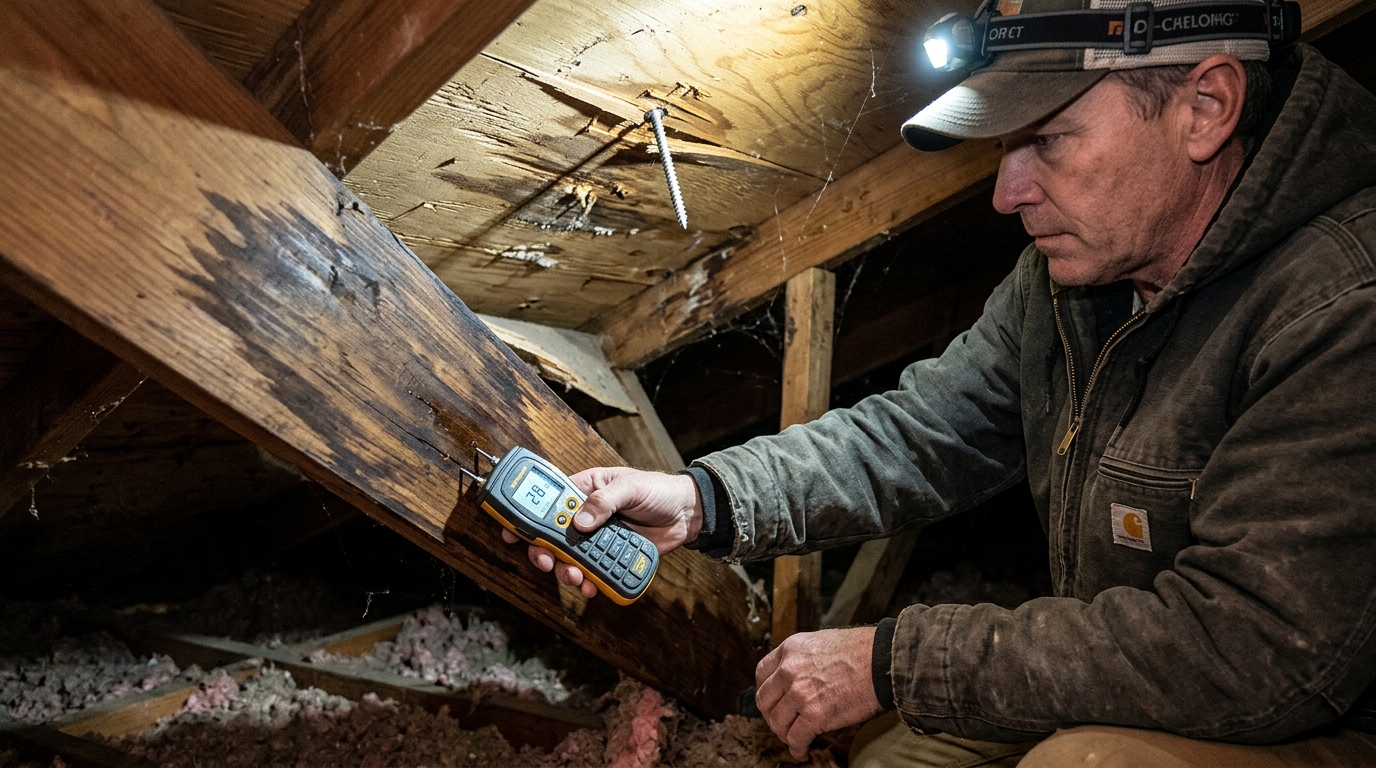
- What to Look For Enter the attic space with a high-lumen flashlight. Examine the plywood roof decking directly beneath the solar panel array. Look for lag screws protruding into empty attic air—known in the roofing trade as "shiners."
- Why It Matters When a lag bolt penetrates roof decking without biting into a rafter, it splits the plywood and creates a permanent funnel for water to enter during heavy rain.
- Documentation Standard Take crisp, wide-angle photos showing the location within the attic framing, followed by close-up photos showing water trails, staining, or active mold running down the protruding bolt.
2. Moisture Meter and Thermal Imaging Mapping
Water travels along roof rafters and electrical conduits before dripping through drywall, often appearing ten feet away from the actual roof breach:
- FLIR / Infrared Thermal Camera Thermal imaging detects evaporative cooling behind drywall and ceiling plaster, creating a color-coded map that traces the water path directly from the ceiling stain back up to the solar bracket penetrations.
- Calibrated Moisture Meter Use a pin or pinless moisture meter to record Wood Moisture Equivalent (WME) percentages. Normal indoor drywall and structural wood measure 5% to 12%. Readings above 20% WME indicate active saturation and structural compromise.
- Documentation Standard Photograph the digital screen of the moisture meter held against the wet rafter or drywall, clearly displaying the elevated percentage.
3. Independent Licensed Roofer's Forensic Causation Affidavit
Never rely on the solar installer's "internal inspection." Hire a third-party, state-licensed roofing contractor (such as a C-39 licensed contractor in California) to inspect the roof:
- The independent roofer must prepare a written Forensic Roof Inspection Report explicitly detailing:
- The exact failure point (e.g., cracked concrete tiles under racking feet, failure to install metal flashing collars, improper use of caulking in lieu of mechanical flashings).
- Confirmation that the leak is not caused by unrelated plumbing flashings, chimney masonry, or pre-existing age.
- An itemized estimate for Remove-and-Reinstall ("R&R") of the solar array plus necessary roof sheathing, underlayment, and drywall repairs.
4. Macro Close-Up Photography of Racking Brackets
If safe roof access is possible (or via a high-resolution drone):
- Capture close-up photos of the mounting brackets, tile cuts, and sealant.
- Document cracked perimeter tiles, bent flashing plates, or degraded roofing mastic that was used as a substitute for certified flashing hardware (e.g., Quick Mount PV or IronRidge flashings).
- Show where caulking applied during prior "resealing" visits has shriveled, cracked under ultraviolet sun exposure, or pooled water.
5. The Chain of Custody & Prior Service Records
Collect every document establishing the timeline:
- Original installation contract and roof warranty language (typically 10 to 25 years for roof penetrations).
- Date and weather reports of the first recorded leak.
- Written records, text messages, or work orders from the installer's previous visits to "reseal" or "inspect" the panels.
- Legal Impact Under Uniform Commercial Code § 2-313, evidence that the company previously dispatched technicians to reseal the roof constitutes documented notice of a defect and destroys their defense that the leak was sudden or pre-existing.
Technical vs. Forensic Standards
| Evidence Type | What the Solar Company Claims | The Forensic Response |
|---|---|---|
| Living room ceiling water stain | "Stains are generic; could be a plumbing leak or old condensation." | Attic rafter moisture meter readings (>20% WME) tracing continuous path directly to solar mounts. |
| Ground-level roof photo | "We can't see the penetrations from the ground; looks intact." | High-resolution drone macro shots showing cracked tiles under mounts and split flashing. |
| Drywall mold growth | "Mold takes years to form; this is pre-existing roof damage." | Certified roofing contractor affidavit confirming underlayment was torn exclusively during solar lag installation. |
| Prior "resealing" visit | "We fixed that as a courtesy; no warranty covers new weather." | Work order serves as a binding admission of prior failure; failure to cure breaches express warranty under UCC § 2-313. |
How to Deploy Your Evidence Package for Maximum Leverage
Once your 5-point dossier is compiled into a single PDF document, unleash it across multiple legal channels simultaneously.
1. The Formal Warranty Default Demand
Send a certified letter with return receipt requested to the solar company’s corporate claims department and legal counsel:
- Attach the independent roofer's causation affidavit and itemized repair invoice.
- Cite their contractual roof penetration warranty.
- Demand payment of the repair invoice within 14 calendar days, stating that failure to cure will result in formal regulatory complaints and legal action for consequential property damages.
2. File a State Contractor Licensing Board Complaint
State licensing boards treat roof leaks and substandard workmanship with severe penalties:
- In California File a complaint with the Contractors State License Board (CSLB) under Cal. Bus. & Prof. Code § 7109 (willful departure from accepted trade standards) and § 7159. The CSLB can order mandatory arbitration and suspend the contractor's license.
- In Florida File with the Department of Business and Professional Regulation (DBPR) under Fla. Stat. § 489.129.
- Contractor Surety Bond Every licensed contractor must maintain a surety bond (typically $25,000 in California). You can file a direct claim against their surety bond surety company for the cost of roof repairs.
3. Issue an FTC Holder Rule Notice to the Solar Lender
If you financed the solar panels through GoodLeap, Mosaic, Sunlight Financial, or dividend finance:
- Under the Federal Trade Commission Holder Rule (16 C.F.R. § 433.2), the financing bank is subject to all claims and defenses you have against the installer.
- Send the complete evidence dossier to the lender's dispute department. State that the contractor has breached the contract by damaging the property and refusing to honor the warranty, entitling you to offset ongoing loan payments against the $10,000 to $30,000 in roofing damages.
4. File a Claim with the Installer's Commercial General Liability (CGL) Carrier
Solar installers are legally required to carry Commercial General Liability (CGL) insurance. Demand the policy number and claims contact. Property damage resulting from faulty installation operations is often covered under their CGL "completed operations" coverage, bypassing the installer’s cash-flow excuses.
FAQ
Why did the solar company deny my roof leak photos?
Solar companies routinely reject cell phone photos of interior drywall stains because interior stains show damage but fail to establish causation. Companies claim the leak could stem from aged roofing felt, plumbing vent boots, or normal wear. Overcoming this denial requires attic rafter moisture readings and an independent roofer's forensic causation report.
The company sent a guy to reseal the mounts with caulk, but it leaked again. What does that mean legally?
A prior "resealing" visit is powerful legal evidence. It proves that the solar company had actual notice of a roof penetration failure and attempted a repair. When the leak persists, it demonstrates a failure of the repair to cure the defect, establishing a clear breach of the contractor's express warranty under Uniform Commercial Code § 2-313.
Will my homeowners insurance cover roof leaks caused by solar panels?
Standard homeowner insurance policies often contain exclusions for "faulty, inadequate, or defective workmanship or installation." If your insurer denies the claim on this basis, they will issue a formal denial letter identifying the solar installer's workmanship as the sole cause. You can use that official insurance denial letter as additional evidence against the solar contractor and their commercial liability insurer.
How much does a professional roof leak causation inspection cost?
A comprehensive forensic inspection by an independent, licensed roofing contractor typically costs between $300 and $750. This fee usually includes attic crawl inspection, moisture meter readings, roof-level photographic analysis, and a signed causation letter with a complete repair estimate. In formal legal disputes or contractor bond claims, this inspection fee is routinely recoverable as an itemized out-of-pocket damage.
Can I stop paying my solar loan while my roof is leaking?
Do not simply cancel auto-pay without formal legal notice, as the lender may initiate negative credit reporting. Instead, submit a formal dispute citing the FTC Holder Rule (16 C.F.R. § 433.2) along with your independent roofing causation report, demanding that loan payments be placed in administrative suspense pending warranty repair or damages setoff.
Sources and Official References
- Federal Trade Commission (FTC) Holder Rule (16 C.F.R. § 433.2) Code of Federal Regulations — eCFR
- California Business and Professions Code § 7109 (Departure from Standards) California Legislative Information — Business and Professions Code
- California Business and Professions Code § 7159 (Home Improvement Contracts) California Legislative Information — Business and Professions Code
- Florida Statutes § 489.129 (Contractor Disciplinary Proceedings) Florida Senate Statutes
- Uniform Commercial Code § 2-313 (Express Warranties by Affirmation) Legal Information Institute (LII) / Cornell Law
- Uniform Commercial Code § 2-314 (Implied Warranty of Merchantability) Legal Information Institute (LII) / Cornell Law
- National Roofing Contractors Association (NRCA) Guidelines for Rooftop Photovoltaic Systems NRCA Technical Publications
- Occupational Safety and Health Administration (OSHA) 29 C.F.R. § 1926.501 (Fall Protection) OSHA Regulations
Next Research Steps
Use these resources to connect this issue with the broader solar scam pattern, the relevant legal framework, and the next practical action.
Solar panel scams
Start with the main solar panel scams guide for the broad definition and recovery roadmap.
Solar company complaint directory
Look up installers, lenders, bankruptcies, warranty problems, and customer-service complaint patterns.
Report solar fraud
Build a complaint packet for the FTC, CFPB, state attorney general, licensing board, or counsel.
Homeowner legal rights
Review cancellation, rescission, UDAP, TILA, Holder Rule, arbitration, and lawsuit options.
Misled by a solar company?
Free 24-hr review · Statutory fee-shifting