Promised a $20,000 Solar Rebate Check That Was Really a Tax Credit? [Florida FDUTPA Guide]
Promised a $15,000-$25,000 rebate check that turned out to be an IRC Section 25D tax credit? How Florida FDUTPA lets homeowners sue for financing fraud.
Disclaimer This article is for consumer educational and informational purposes only and does not constitute formal legal advice. For representation regarding a Florida solar dispute, consult a licensed Florida consumer protection attorney.
Overview
A recurring, highly deceptive sales pitch recorded across Florida legal Q&A forums, Reddit, and Better Business Bureau complaints involves the "guaranteed government rebate check".
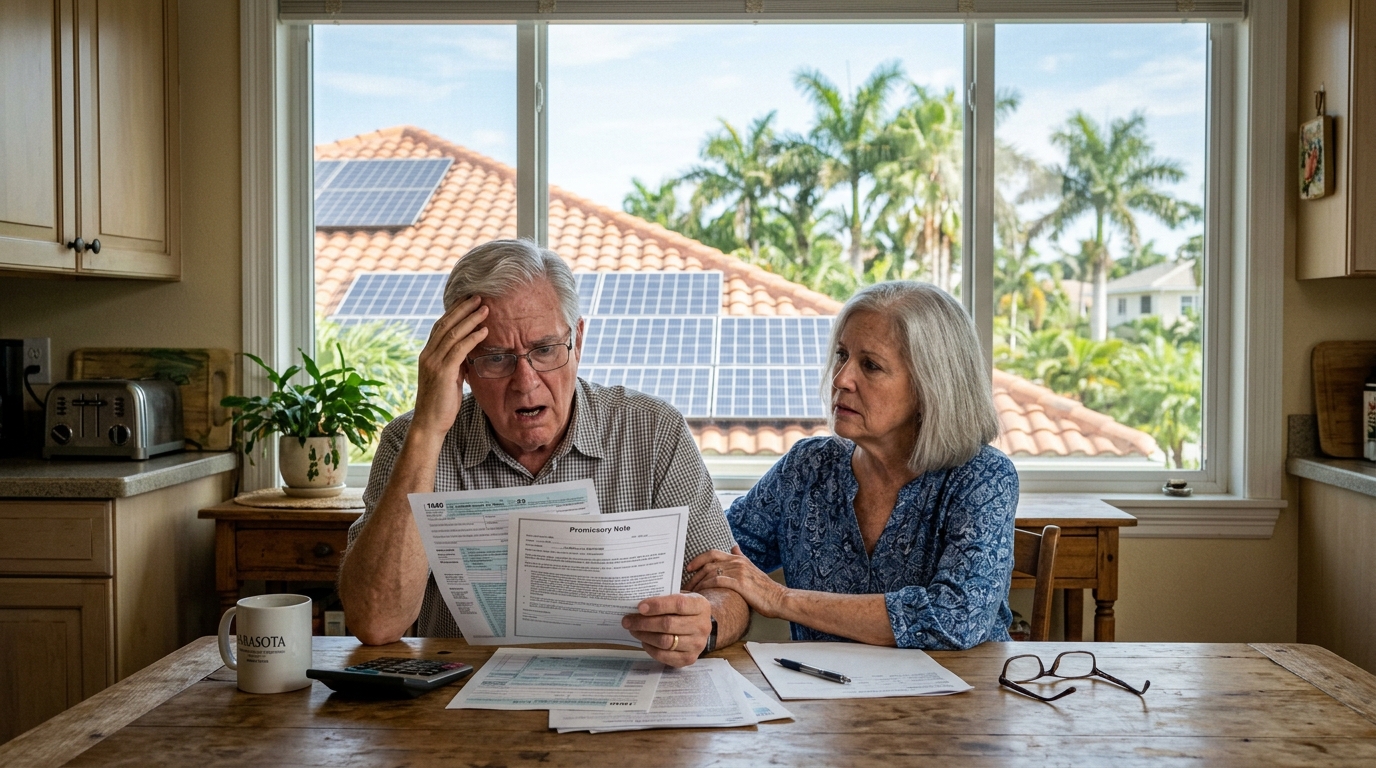
"The door-to-door solar salesman told me that after 18 months, I would receive a direct government stimulus check for $20,000 to pay down my solar loan. When the check never arrived, my lender (GoodLeap / Mosaic) told me it was actually a federal tax credit, and they hiked my monthly payment from $185 to $295. Can I sue to recover this $20,000 in Florida?"
          THE "GOVERNMENT REBATE CHECK" DECEPTION

  [Sales Pitch: "Direct $20,000 Check"]  ──>  [Homeowner Signs $60,000 Loan]
    ("The government pays you back")            (Initial Monthly Bill: $185)
                  │                                           │
                  ▼                                           ▼
  [Reality: Non-Refundable IRC § 25D]   ──>  [Month 18 Balloon Payment Spike]
    (No tax liability = $0 from IRS)            (Payment Jumps Permanently to $295)
                  │                                           │
                  ▼                                           ▼
  [Florida FDUTPA Claim: Fla. Stat. § 501.204]  [FTC Holder Rule Rescission]
    • Deceptive financing misrepresentation        • Mandatory attorney fee-shifting
This pitch is not a simple misunderstanding; it is a calculated, fraudulent misrepresentation designed to make an expensive $50,000 to $80,000 solar installation seem affordable.
In Florida, promising a "rebate check" when the incentive is actually a non-refundable federal tax credit under Internal Revenue Code Section 25D (26 U.S.C. § 25D) is an actionable violation of the Florida Deceptive and Unfair Trade Practices Act (FDUTPA, Fla. Stat. § 501.204). Homeowners who were deceived have statutory rights to hold both the contractor and the solar lender liable.
Key Takeaways
- Rebate vs. Tax Credit A rebate is guaranteed cash sent directly to the consumer. The federal solar incentive is a non-refundable tax credit, which can only reduce federal income tax liability you already owe. Retirees, seniors on Social Security, and low-income families get $0 from the IRS.
- The Month 18 Balloon Trap Lenders (including GoodLeap, Mosaic, Dividend, and Sunlight Financial) set initial payments on the assumption that you will hand over 30% of the loan principal before Month 18. When no rebate check arrives, the loan automatically re-amortizes with a permanent 30% to 45% monthly payment jump. (Read our detailed breakdown on the Sunlight Financial payment increase at Month 19 and federal solar tax credit timing rules).
- Florida FDUTPA Liability Under Fla. Stat. § 501.204, representing a tax credit as a "direct cash check" constitutes an unfair and deceptive trade practice under Florida solar fraud consumer rights.
- Statutory Fee-Shifting Under Fla. Stat. § 501.2105, prevailing consumers recover their full attorney’s fees from the deceptive company, enabling consumer attorneys to take these cases on contingency.
The Mechanics of the "Rebate Check" Fraud
Sales representatives working for predatory solar marketing companies routinely target Florida homeowners—especially elderly residents and fixed-income retirees—using standardized misleading scripts.
1. The "Inflation Reduction Stimulus" Lie
Sales reps show visual pitch decks claiming the homeowner has qualified for a "state or federal solar incentive program" that issues a direct payout after 12 to 18 months. They tell the homeowner:
- "You don’t have to pay for 30% of the system—the government gives you a $20,000 rebate check."
- "When you get the check in the mail, you just sign it over to the lender."
- "Your monthly payment is locked at $185 for the next 25 years."
2. The Tax Reality Under IRC Section 25D
Section 25D is non-refundable:
- If you owe $0 in federal income taxes (common among retirees whose primary income is Social Security or tax-exempt pensions), your credit is worth $0. The IRS does not write checks for unused residential energy credits.
- Even if you have tax liability, you only receive the benefit as a reduction on Form 1040, not as a standalone $20,000 cash delivery.
3. The Re-Amortization Cliff
When Month 18 arrives and the lender does not receive a $20,000 voluntary prepayment, the promissory note automatically triggers a re-amortization clause. The unpaid 30% principal is spread across the remaining loan term with interest, causing the monthly payment to escalate violently.
Your Legal Weapon: The Florida Deceptive and Unfair Trade Practices Act (FDUTPA)
Under Florida law, consumer protection is governed by the Florida Deceptive and Unfair Trade Practices Act (Fla. Stat. § 501.201 et seq.).
"Unfair methods of competition, unconscionable acts or practices, and unfair or deceptive acts or practices in the conduct of any trade or commerce are hereby declared unlawful." (Fla. Stat. § 501.204).
Elements of a Florida Solar Rebate Claim:
To prevail under FDUTPA, an aggrieved homeowner must prove three basic elements:
- A Deceptive Act or Unfair Practice The sales representative affirmatively represented that the homeowner would receive a $20,000 cash rebate or government check.
- Causation The consumer reasonably relied on this representation when deciding to sign the contract and loan promissory note.
- Actual Damages The consumer suffered economic harm—namely, the unexpected $20,000 debt balance and the escalated monthly loan payments.
Florida courts have repeatedly held that deceptive sales pitches regarding financing terms and government program affiliations violate FDUTPA as a matter of law.
Holding the Solar Lender Liable: The FTC Holder Rule
When homeowners discover they were misled, installers often say: "Your salesman was an independent dealer; we are not responsible." Meanwhile, the lender says: "We are just the financing bank."
This pass-the-buck defense is dismantled by the FTC Holder Rule (16 CFR Part 433).
"Any holder of this consumer credit contract is subject to all claims and defenses which the debtor could assert against the seller of goods or services obtained pursuant hereto or with the proceeds hereof."
Because your GoodLeap, Mosaic, or Dividend promissory note contains this mandatory federal notice, your FDUTPA claims against the sales company can be asserted directly against the lender.
Borrowers can demand that the lender:
- Rescind the Month 18 payment increase and permanently lock the loan at the original promised payment.
- Credit the full $20,000 against the outstanding principal balance.
- Cancel the loan note entirely if the deception induced the entire transaction.
Step-by-Step Action Plan to Recover Your Money
If you were promised a solar rebate check that never arrived in Florida, take these four decisive steps.
  STEP 1: Gather Sales Materials & Communications
    └── Locate pitch sheets, text messages, emails, and notes mentioning a "rebate check."
         │
  STEP 2: Review Your 1040 Tax Returns with a CPA
    └── Establish that you could not monetize the 30% Section 25D credit due to low tax liability.
         │
  STEP 3: Serve a Formal FDUTPA Pre-Suit Demand Letter
    └── Send certified demand to the installer and solar lender giving 30 days to resolve.
         │
  STEP 4: File Complaints with the Florida Attorney General & CFPB
    └── File formal complaints with AG Ashley Moody's Consumer Protection Division.
1. Collect Evidence of the "Rebate" Pitch
Look through your records for:
- Text messages or emails from the sales rep promising a "check in the mail" or "stimulus funds."
- The original glossy proposal showing a "net cost after rebate."
- Handwritten notes or calculation sheets left by the representative at your kitchen table.
2. Confirm Tax Ineligibility
Obtain a written statement from your tax preparer or CPA confirming that your federal tax liability was insufficient to utilize the Section 25D credit. This proves direct economic injury.
3. Issue a Formal Written Demand Letter
Send a formal letter via Certified Mail to the solar installer and the lender:
- Detail the exact date, representative name, and words used to promise the $20,000 rebate check.
- Cite Fla. Stat. § 501.204 and 16 CFR Part 433.
- Demand that the lender adjust the loan balance to reflect the promised $20,000 reduction and cancel the balloon payment increase.
4. Retain a Florida Consumer Protection Attorney
Under Fla. Stat. § 501.2105, the prevailing party in an FDUTPA action is entitled to recover reasonable attorney’s fees and court costs. Because of this statutory fee-shifting provision, consumer rights attorneys regularly represent defrauded Florida homeowners on contingency, requiring no upfront out-of-pocket legal fees.
For more details on Florida solar regulations, read our complete Florida Solar Fraud Guide.
Sources and Official References
- Florida Senate: Florida Deceptive and Unfair Trade Practices Act (Fla. Stat. § 501.204)
- Florida Senate: Attorney's Fees Under FDUTPA (Fla. Stat. § 501.2105)
- Federal Trade Commission: The Holder Rule (16 CFR Part 433)
- Internal Revenue Service: Residential Clean Energy Credit (Section 25D)
- Florida Attorney General Ashley Moody: Consumer Protection Division
FAQ
Can I sue a solar company in Florida for promising a rebate check that was really a tax credit?
Yes. Promising a direct cash rebate check when the incentive is actually a non-refundable tax credit under Internal Revenue Code Section 25D is a direct violation of the Florida Deceptive and Unfair Trade Practices Act (FDUTPA). Defrauded consumers can seek actual damages, debt cancellation, and reimbursement of their legal fees.
What if the salesman told me verbally that I would get a check, but the contract says "tax credit"?
While solar contracts contain fine-print disclaimers stating that the homeowner should consult a tax professional, Florida courts have recognized that deceptive verbal pitches and sales presentations that actively mislead consumers cannot simply be excused by boilerplate disclaimers. Oral misrepresentations that induce the signing of a predatory contract remain actionable under FDUTPA and common law fraud.
How does the FTC Holder Rule help me with my solar loan in Florida?
The FTC Holder Rule (16 CFR Part 433) makes your financing company (such as GoodLeap or Mosaic) legally liable for the fraudulent acts and deceptive sales pitches of the solar contractor. This means you do not have to chase a bankrupt or disappearing sales company—you can assert your fraud claims directly against the lender holding your loan.
Why did my monthly solar loan payment jump after 18 months?
Solar promissory notes are designed with an artificial re-amortization period. The lender calculates your first 17 payments on the assumption that you will receive a 30% tax credit and immediately pay that entire sum down on the loan principal. If you do not make this large voluntary prepayment before Month 18, the lender recalculates the loan balance over the remaining term, resulting in a 30% to 45% payment increase.
How do Florida consumer lawyers get paid in solar fraud cases?
Under Florida Statutes § 501.2105, if you prevail in a lawsuit under FDUTPA, the court orders the deceptive solar company or lender to pay your reasonable attorney's fees. This statutory fee-shifting enables consumer attorneys to represent homeowners on a contingency fee basis with no upfront retainer.
Next Research Steps
Use these resources to connect this issue with the broader solar scam pattern, the relevant legal framework, and the next practical action.
Solar panel scams
Start with the main solar panel scams guide for the broad definition and recovery roadmap.
Solar financing fraud compensation
Use this guide for loan, dealer-fee, payment-jump, PACE, lease, and lender-defense issues.
Solar panel scams and ripoffs
Compare scam patterns, red flags, door-to-door pressure, fake rebates, and impersonation tactics.
Homeowner legal rights
Review cancellation, rescission, UDAP, TILA, Holder Rule, arbitration, and lawsuit options.
Misled by a solar company?
Free 24-hr review · Statutory fee-shifting