Door-to-Door Solar Scams: High-Pressure iPad Tactics & Forgery
How deceptive door-to-door solar canvassers use iPad signing tricks, utility impersonation, and hidden loan terms to trap homeowners.
Disclaimer This guide provides consumer educational reporting, fraud prevention analysis, and statutory dispute protocols regarding direct door-to-door sales practices. It does not constitute formal legal advice. If you suspect an unauthorized contract was signed on your behalf, consult a licensed consumer-protection attorney.
Overview
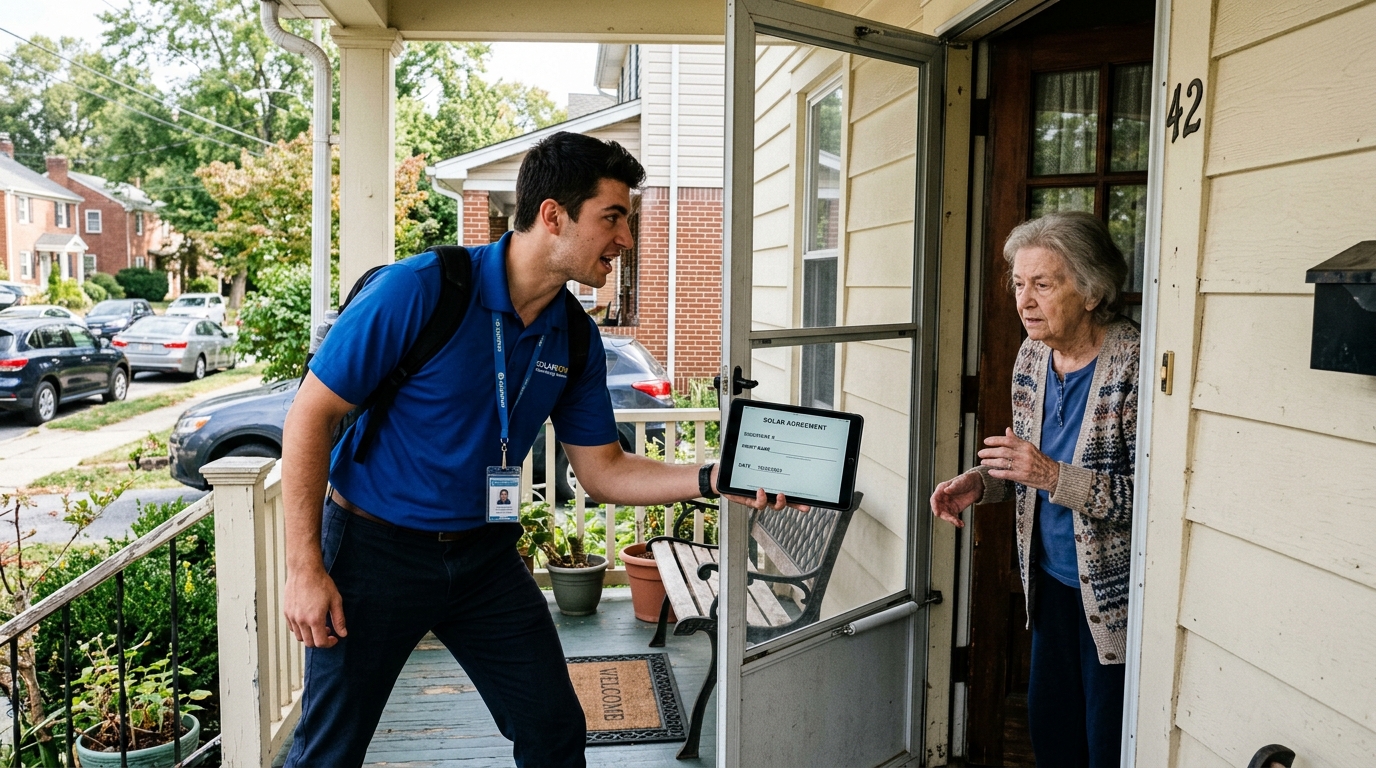
The doorbell rings at 6:30 PM. Standing on your porch is a young, energetic person carrying an iPad, wearing an orange safety vest or a lanyard featuring your local power company's color scheme.
Their pitch sounds completely harmless:
- "I'm just with the regional clean energy initiative checking to see if your roof qualifies for the zero-cost state program."
- "We're auditing the electric bill spikes caused by the latest grid rate hike."
- "I just need to take a quick picture of your utility bill to confirm your meter number."
- "Just tap your finger right here on my iPad so my supervisor knows I stopped by."
Two weeks later, you receive a welcome email from an unfamiliar finance company—GoodLeap, Sunlight Financial, Mosaic, or Dividend—congratulating you on your $75,000, 25-year solar loan at 10.99% interest with a UCC-1 fixture filing attached to your county property records.
You were never told you were taking out a loan. You never saw a contract. You thought you were signing an eligibility check.
This is the grim reality of predatory door-to-door solar canvassing. Here is how the trap works, how sales reps manipulate tablets to bypass your consent, and how federal and state law lets you rip these contracts to shreds.
Important Caution If you are trying to escape a fraudulent solar agreement, beware of fly-by-night operations claiming to eliminate solar debt for upfront fees. Read our breakdown on Solar Debt Relief Scams to stay protected.
The 4 Signature Tricks of Door-to-Door Reps
Door-to-door solar sales reps are almost never direct employees of the solar panel manufacturer or the financing bank. They are typically 100% commission-based 1099 contractors working for aggressive sales dealerships. If they don't close your contract, they don't make rent. That economic pressure breeds calculated deception.
                           THE IPAD SALES TRAP
 ┌─────────────────────────┐             ┌─────────────────────────┐
 │   The Utility Pretext   │             │   The Digital Sleight   │
 │ • Safety vest & lanyard │             │ • Zoomed-in signature box│
 │ • "Neighborhood audit"  │────────────►│ • Contract terms hidden │
 │ • Snaps photo of bill   │             │ • "Just sign for visit" │
 └─────────────────────────┘             └─────────────────────────┘
                                                      │
                                                      ▼
 ┌─────────────────────────┐             ┌─────────────────────────┐
 │     The Credit Trap     │             │    The Burner Email     │
 │ • Hard credit pull run  │             │ • Rep enters fake email │
 │ • Rep submits loan app  │◄────────────│ • Homeowner never gets  │
 │ • UCC-1 lien generated  │             │   DocuSign cancel notice│
 └─────────────────────────┘             └─────────────────────────┘
1. The Zoomed-In Screen Trick
When handing you an iPad, reps frequently zoom in directly onto the digital signature box or use stylus tools that hide the document headers. They tell you: "This just acknowledges that I presented the proposal to you today." In reality, that signature box is attached to a 45-page retail installment contract and promissory note.
2. The Burner Email Address Scheme
Under federal and state law, you have statutory rights to cancel door-to-door sales contracts within a specific cooling-off window (typically 3 business days). To prevent you from seeing the contract or exercising your cancellation right, unscrupulous reps enter a fake or burner email address (e.g., yourname.solarupdate@gmail.com) on the financing application.
- The lender sends the DocuSign confirmation and cancellation notice to the burner address.
- The 3-day cooling-off window quietly expires.
- You only discover the loan weeks later when the physical welcome letter arrives in your mailbox.
3. Utility Impersonation & Government Affiliation Lies
Canvassers routinely use deceptive phrasing to imply they are affiliated with public utilities (PG&E, ConEd, Duke Energy, Oncor, FPL) or government programs:
- "I'm here from the net metering task force."
- "The state mandate requires your neighborhood to switch to tier-one solar."
- "This is an approved state-subsidized program with no cost to homeowners."
No state or federal government program hands out free residential solar systems to private homeowners. These are commercial retail installment loans or 25-year power purchase agreements.
4. The Bait-and-Switch Dealer Fee
Sales reps tout "low monthly payments" and "low APRs" (such as 2.99% or 3.99%), but deliberately conceal that the solar dealer baked a 20% to 35% hidden dealer fee into the total financed cost. A system that should cost $30,000 cash is marked up to $42,000 to subsidize the lender's interest rate.
Start the eligibility review →
Federal and State Laws That Protect You
If an aggressive canvasser manipulated you into an unauthorized solar agreement, several powerful consumer protection statutes provide an escape hatch.
The FTC Cooling-Off Rule (16 C.F.R. § 429)
Federal law gives you an absolute right to cancel any sale made at your personal residence valued over $25 within three business days. Crucially:
- The salesperson is legally required to provide you with two physical copies of a written Notice of Cancellation form at the exact moment of sale.
- They must orally inform you of your right to cancel.
- If they fail to provide the required cancellation forms and disclosures, your right to cancel does not expire in 3 days—it extends indefinitely until proper disclosures are delivered.
The Fair Credit Reporting Act (FCRA, 15 U.S.C. § 1681b)
A solar sales rep cannot run a hard inquiry on your credit without a permissible purpose and your explicit, verifiable authorization. If a canvasser snapped a photo of your electric bill and used your personal identifying information to pull your credit report without your knowledge, they committed a willful violation of the FCRA, entitling you to statutory damages of up to $1,000 per violation.
Fraud in the Factum / Lack of Mutual Assent
If you were told you were signing an inspection acknowledgment or receipt, but your signature was applied to a promissory note, the contract suffers from fraud in the factum. Under basic contract law, a contract procured through deception regarding the very nature of the document is void ab initio (void from the very beginning), rendering the entire loan and any arbitration clause legally unenforceable.
How to Cancel a Door-to-Door Solar Contract
If a canvasser visited your home and you suspect an unauthorized contract was created, act immediately.
Step 1: Check Your Email & Credit Reports
  └─ Look for inquiries from GoodLeap, Sunlight, Mosaic, or Dividend.
  └─ Check spam folders for DocuSign or PandaDoc transaction notifications.

Step 2: Send a Formal Notice of Rescission
  └─ Send via USPS Certified Mail with Return Receipt Requested.
  └─ State clearly: "I cancel this transaction under 16 C.F.R. § 429 and state consumer protection law."
  └─ Send copies to both the solar installation company and the finance lender.

Step 3: Freeze Your Credit & File a Police Report (If Forged)
  └─ If your signature was forged or an unauthorized email used, file an identity theft report.
  └─ File at IdentityTheft.gov and with your local police department.

Step 4: File Complaints with Regulators
  └─ State Attorney General's Consumer Protection Division.
  └─ Federal Trade Commission (ReportFraud.ftc.gov).
  └─ Consumer Financial Protection Bureau (CFPB) for the lending institution.
FAQ
Can I cancel a door-to-door solar contract after 3 days?
Yes, under multiple circumstances. If the sales rep failed to provide two written copies of the statutory Notice of Cancellation form, failed to verbally explain your cancellation rights, or committed fraudulent misrepresentation during the sales pitch, the statutory cooling-off window is tolled (extended) under federal law. Furthermore, if your signature was forged or misrepresented, the contract is void.
What should I do if the sales rep refuses to leave my property?
You have the absolute right to demand that any solicitor leave your private property immediately. If they refuse, argue, or attempt to intimidate you, call local law enforcement. Document their name, company badge, vehicle license plate, and any promotional materials left behind.
Is it legal for a solar rep to pretend they work for my electric company?
No. Misrepresenting business identity or falsely claiming affiliation with a regulated public utility or government agency is an unfair and deceptive trade practice under both state law and FTC regulations. You should immediately report such conduct to your state public utilities commission and the state Attorney General.
What To Do Next
If you or an elderly family member were targeted by aggressive door-to-door solar canvassers:
- Do not allow installers onto your roof.
- Demand the complete DocuSign audit trail and signed paperwork in writing.
- Submit your details for a free eligibility evaluation to review contract cancellation and dispute options.
Next Research Steps
Use these resources to connect this issue with the broader solar scam pattern, the relevant legal framework, and the next practical action.
Solar panel scams
Start with the main solar panel scams guide for the broad definition and recovery roadmap.
Solar panel scams and ripoffs
Compare scam patterns, red flags, door-to-door pressure, fake rebates, and impersonation tactics.
Solar financing fraud compensation
Use this guide for loan, dealer-fee, payment-jump, PACE, lease, and lender-defense issues.
Homeowner legal rights
Review cancellation, rescission, UDAP, TILA, Holder Rule, arbitration, and lawsuit options.
Misled by a solar company?
Free 24-hr review · Statutory fee-shifting