UCC-1 Solar Fixture Filings & Home Sale Risks [Explained]
Clarifies UCC-1 filings on solar equipment: what they are, how they differ from property liens, when they create title problems, and how to protect your home.
Listen: UCC-1 Solar Fixture Filings & Home Sale Risks [Explained]
Spoken audio investigation (11 min narration)
A solar UCC-1 usually does not mean the company owns your home, but it can still block a sale or refinance. The risk depends on whether the filing is limited to solar equipment, treats panels as fixtures, or uses broad collateral language that title companies and lenders will not accept.
The governing framework is Article 9 of the Uniform Commercial Code, and the document that clears a filing is a UCC-3 termination statement under UCC § 9-513.
Disclaimer This article is for informational purposes only and does not constitute legal advice. Consult an attorney for analysis of any specific UCC filing against your property.
Overview
You run a title search on your home and discover something you did not expect: a UCC-1 financing statement filed by a solar company. You never agreed to a lien. The salesperson never mentioned it. Now you are wondering — is your home at risk?
The answer depends on what type of UCC-1 was filed, what it encumbers, and whether it was properly authorized. A UCC-1 is not automatically a lien on your house, but it can create serious title problems. Understanding the difference between a fixture filing, an equipment lien, and a general lien — and knowing how to get a UCC-3 termination — is critical for any homeowner facing this situation.
If the filing appeared after a door-to-door sale or confusing finance document, compare it with the solar financing scams guide and the solar dealer fees explainer. The lien issue is often only one piece of a broader contract trap.
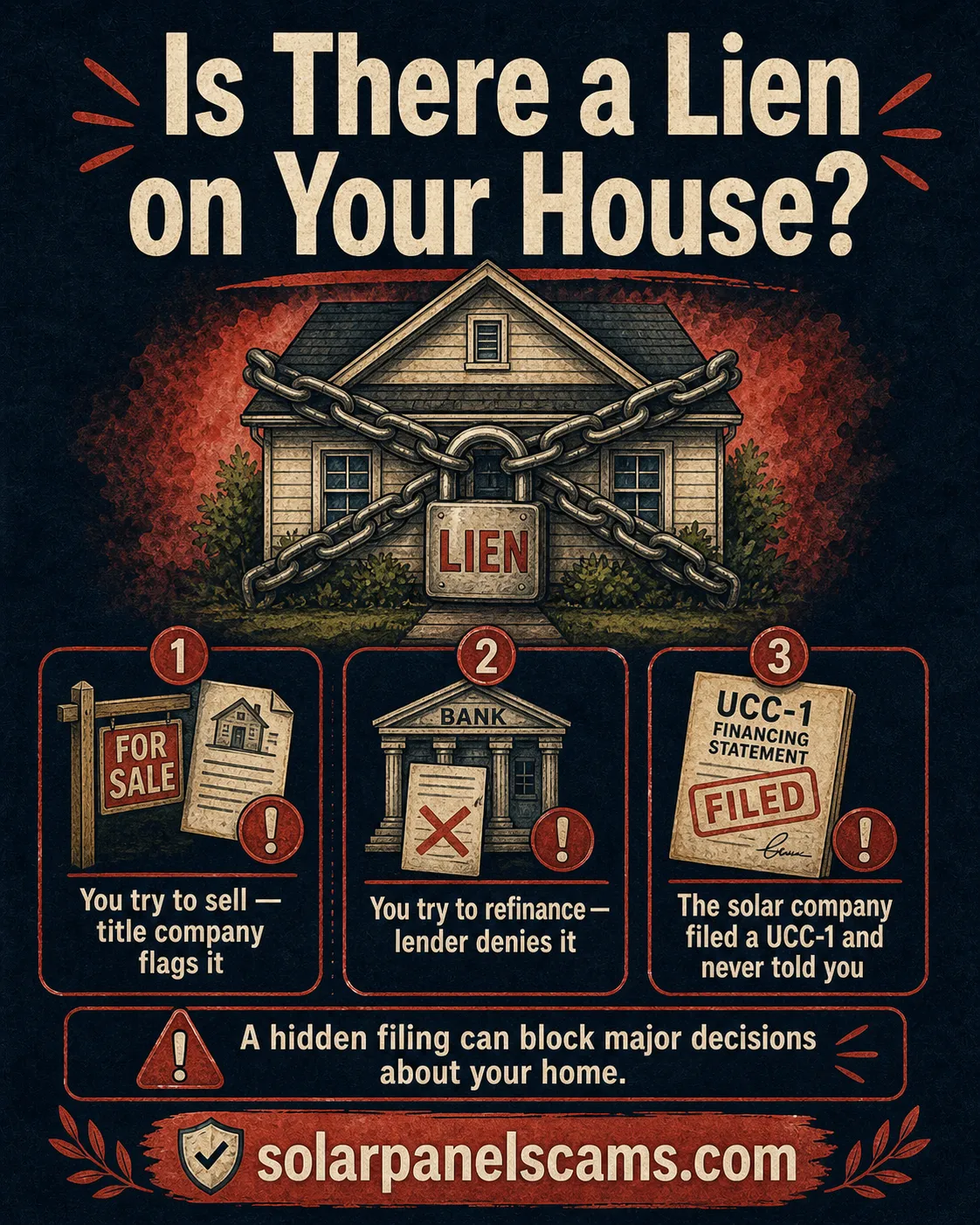
Use the warning signs in the graphic as your triage point. If a title company, mortgage lender, realtor, or buyer flags a solar UCC-1, immediately request the filing record, the collateral description, and any payoff or transfer demand from the solar lender. Those documents determine whether you are dealing with a routine equipment filing or a broader title problem.
Self-Diagnosis: Which Filing Is On Your Record?
Pull the filing and read the collateral description, then find your row. The row you land on determines both how serious the filing is and which document removes it.
| Filing type | What it actually secures | Where it shows up | How it gets removed |
|---|---|---|---|
| UCC-1 fixture filing (most common) | The solar equipment only — panels, inverters, racking — not your land or dwelling | Secretary of State records, county recorder, and the title report | UCC-3 termination filed by the secured party after payoff, cancellation, or an unauthorized filing |
| UCC-1 general or blanket lien | Collateral described broadly enough to encumber the entire property, not just the equipment | Title report, flagged as an encumbrance that blocks a conforming loan | Must be released or subordinated before closing; wrongful-filing remedies under UCC 9-625 if the filing was improper |
| UCC-1 tied to a PPA or lease | Equipment the solar company already owns, filed to create additional leverage | Title report, often for the full 20–25-year contract term | UCC-3 termination, subordination, or transfer of the contract to a qualified buyer |
| Mechanics lien | Unpaid work performed by a contractor or subcontractor — a statutory lien, not one you agreed to | Recorded against the property and picked up in title review | State mechanics-lien procedure, not Article 9 — a different framework with different remedies |
What a UCC-1 Actually Is (and What It Is Not)
A UCC-1 financing statement is a public record, filed under Article 9 of the Uniform Commercial Code, that gives notice of a creditor's security interest in specific collateral. In solar transactions, the UCC-1 serves one of two purposes:
- Fixture filing (most common). The solar panels are "fixtures" — goods that have become so attached to real property that an interest in them arises under real property law. A UCC-1 fixture filing gives the solar company a security interest in the equipment (panels, inverters, racking) — not your entire home. When properly filed, it puts other creditors and title examiners on notice that the panels are encumbered.
General lien (dangerous). Less common but more serious — some solar contracts authorize a UCC-1 that describes the collateral broadly enough to encumber the entire property, not just the equipment. This crosses the line from equipment lien to blanket lien on real estate.
A UCC-1 is not a mortgage, not a deed of trust, and not a judgment lien. But it shows up on title reports, and title examiners, lenders, and buyers treat it as an encumbrance that must be addressed before a sale or refinance can close.
Three Scenarios: Which One Applies to You?
1. Solar Loan (You Own the Panels)
If you financed your solar panels through a loan — and you own the system — the lender typically files a UCC-1 fixture filing to secure its interest in the equipment. This is similar to a car loan: the lender has a lien on the collateral (the panels), not your house. When the loan is paid off, the lender must file a UCC-3 termination statement to release the lien.
2. PPA or Lease (They Own the Panels)
If you signed a PPA or lease, the solar company owns the equipment. The UCC-1 in this scenario is often unnecessary — it duplicates the ownership interest the company already holds. But companies file them anyway to create additional leverage. These UCC-1s can persist for the full 20–25-year term and complicate any sale or refinance.
3. Clerical Errors or Unauthorized Filings
In some cases, UCC-1 filings are made without proper authorization or contain errors — wrong debtor name, inflated collateral description, or filing in the wrong jurisdiction. These defects can support a challenge to the filing's validity.
How UCC-1s Complicate Sales and Refinancing
When you try to sell or refinance, the title company pulls a report. The UCC-1 appears. The title officer does not always parse whether it is a fixture filing or a general lien — they see an encumbrance and flag it. To clear the title, one of three things must happen:
- The UCC-1 is terminated via a UCC-3 termination statement.
- The UCC-1 is subordinated, meaning the creditor agrees to take a lower priority.
- The underlying obligation is paid off or the contract is transferred to a qualified buyer.
The distinction between fixture filing and general lien matters enormously here. A fixture filing on equipment that will be transferred with the property should not kill a sale — but it often does, because title officers, agents, and lenders are not always versed in UCC nuances.
Freddie Mac and Fannie Mae Requirements
Freddie Mac and Fannie Mae both govern solar panel UCC-1 filings in their selling guides:
- Fixture filings on equipment only are generally acceptable if the equipment will remain with the property and the filing does not encumber the land or dwelling.
- General liens or blanket filings that encumber the real property are not acceptable and must be released or subordinated before closing.
- If the UCC-1 is tied to a PPA or lease, lenders must verify that the contract terms do not create unacceptable restrictions on the property.
The practical effect: if a UCC-1 is worded too broadly, it can block a conforming loan — even if the filing was never intended to be a real property lien.
How to Get a UCC-3 Termination
A UCC-3 is the form used to amend, assign, continue, or terminate a UCC-1. To get a termination:
- Determine the basis for termination. The most common grounds: the loan is paid off, the contract is canceled, or the filing was unauthorized.
- Demand termination in writing. Send a certified letter to the solar company or lender, citing the basis and requesting a UCC-3 termination within the statutorily required timeframe (often 20–30 days).
- If they refuse or ignore you, escalate. File a complaint with the Secretary of State or county recorder's office. In some states, wrongful refusal to terminate a UCC-1 carries statutory penalties.
- Consider legal action for wrongful filing. Under UCC 9-625, a secured party that fails to comply with Article 9 duties may be liable for damages, including any loss caused by the failure. Some states also have specific wrongful-lien statutes.
Wrongful-Filing Remedies
If a solar company filed a UCC-1 without authorization, filed an overbroad collateral description, or refuses to terminate after the underlying obligation is satisfied, remedies include:
- UCC 9-625 Liability for failure to comply with Article 9, including damages for any loss.
- State wrongful-lien statutes Many states (California Civil Code 8480, South Carolina UCC filing provisions, Florida Statute 559.77) provide for statutory damages, attorney's fees, and expedited procedures for removing wrongful liens.
- UDAP / consumer protection claims Filing a false or misleading UCC-1 may constitute an unfair or deceptive act under state consumer protection statutes.
- Demand letter with statutory threat Often, a well-crafted letter citing the applicable wrongful-lien statute is enough to produce a UCC-3 termination.
Before you send a demand, preserve the contract, filing record, payment history, and closing/title emails using the solar scam evidence checklist.
Official Sources to Check
- Uniform Commercial Code Article 9 overview
- Fannie Mae Selling Guide: special property eligibility considerations
- Freddie Mac Single-Family Seller/Servicer Guide section 5601.4
- CFPB complaint portal
- FTC ReportFraud intake
FAQ
Why do solar companies put a lien on your house?
Two reasons. On a solar loan, the lender files a UCC-1 fixture filing to secure its interest in the equipment — panels, inverters, racking — the way a car lender secures the car. On a PPA or lease, the company already owns the equipment, and the filing is often unnecessary but gets made anyway to create additional leverage.
Does a solar loan put a lien on your house?
Typically not on the house itself. A properly filed UCC-1 fixture filing encumbers only the solar equipment, not your land or dwelling. The risk comes from broad collateral language: some contracts authorize a filing described broadly enough to encumber the entire property, which crosses from equipment lien into blanket lien.
Does a UCC-1 mean the solar company owns my house?
No. A proper UCC-1 fixture filing encumbers only the solar equipment — panels, inverters, and related components — not your land or dwelling. However, if the collateral description is overly broad, it can appear to encumber more than the equipment, which is why the language matters.
Will a solar lien block my home sale or refinance?
A solar UCC-1 fixture filing can cloud real property title and stall mortgage refinancing until cleared. Title officers do not always parse whether a filing is a fixture filing or a general lien — they see an encumbrance and flag it. Clearing title takes a UCC-3 termination, a subordination, or payoff or transfer of the underlying obligation. Wording that is too broad can block a conforming loan outright.
How do I know if there is a UCC-1 on my property?
Order a title search through a title company or check with your county recorder and Secretary of State's office. Many states offer free online UCC searches. You can also request a copy of any UCC-1 filing from the filing office.
What is the difference between a UCC-1 and a mechanics lien?
A UCC-1 is a consensual security interest — you agreed to it (or the contract purports that you did). A mechanics lien is a statutory lien filed by a contractor or subcontractor who performed work and was not paid. Both can cloud title, but they arise from different legal frameworks and have different remedies.
How do I get a UCC-1 filing removed?
Only the secured party named on the UCC-1 can file a UCC-3 termination — you cannot file it yourself. Demand it in writing and state the ground: paid-off loan, canceled contract, or unauthorized filing. If they refuse, you may need to pursue legal remedies.
How long does a UCC-1 last?
A UCC-1 is effective for 5 years from the filing date and can be continued for additional 5-year periods by filing a UCC-3 continuation statement. For solar leases and PPAs with 20–25 year terms, the UCC-1 is typically continued multiple times. If not continued, it lapses and becomes ineffective.
Got blindsided by a solar deal that did not deliver?
You may have a claim — and the law may make the company that defrauded you pay your legal fees. Our 2-minute eligibility check screens for the consumer-protection statutes that apply to your situation (TILA § 130, the FTC Holder Rule, your state UDAP) and connects you with a consumer-protection attorney in our network if you qualify. Use the eligibility form to route your facts through the right intake path.
Next Research Steps
Use these resources to connect this issue with the broader solar scam pattern, the relevant legal framework, and the next practical action.
Solar panel scams
Start with the main solar panel scams guide for the broad definition and recovery roadmap.
Solar financing fraud compensation
Use this guide for loan, dealer-fee, payment-jump, PACE, lease, and lender-defense issues.
Solar fraud by state
Compare state and city issues against the national solar fraud map.
Misled by a solar company?
Free 24-hr review · Statutory fee-shifting