Solar Scams Targeting Seniors: A Family Protection Guide
Family guide to solar scams targeting seniors: warning signs, door-to-door pressure, contract traps, and steps to protect elderly homeowners.
Solar scams targeting seniors usually combine isolation, urgency, and complex financing. Families should treat surprise panels, new loan mail, unexplained solar payments, or a UCC filing as a time-sensitive consumer-protection problem, not as ordinary buyer's remorse.
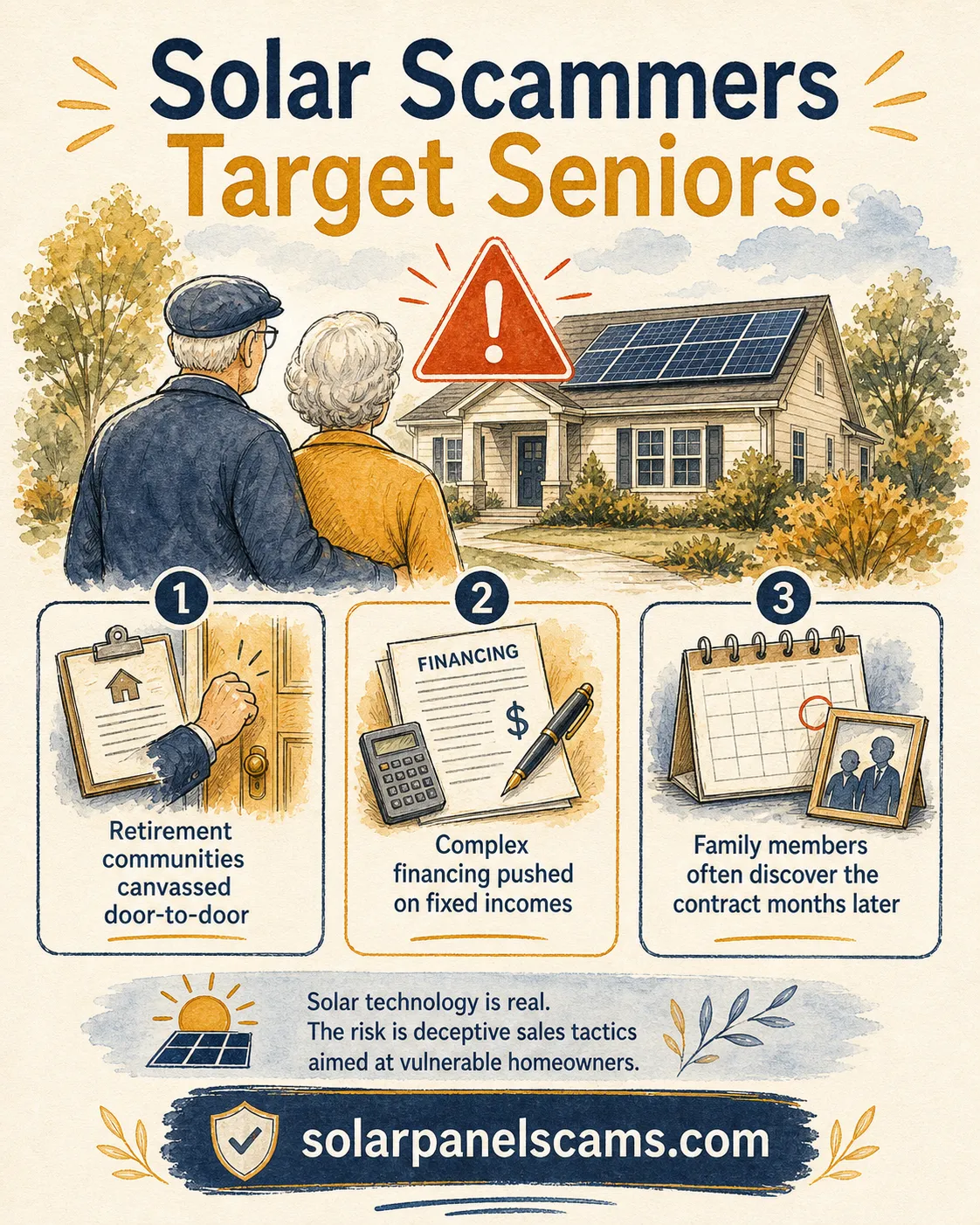
Disclaimer: This article is informational, not legal advice. If an elderly loved one has been affected by a solar scam, consult an elder law or consumer protection attorney in their state.
Overview
If you are an adult child of aging parents, this scenario may already be familiar: you visit and notice something on the roof that was not there before. Panels. Your parent mentions, almost casually, that "some nice young person" stopped by a few weeks ago and helped them save money on electricity. You ask to see the paperwork. What you find is a 25-year contract with payments that escalate every year, a lien against a home your parents spent 30 years paying off, and a company that will not return your calls.
This is not a rare occurrence. It is one of the most pervasive patterns in American consumer scams. Solar companies — some technically legal, others outright criminal — have built business models around targeting senior citizens. The targeting is not accidental. It is supported by demographic data, refined sales scripts, and compensation structures that reward closing elderly homeowners above all others.
This guide is written for the family members — the adult children, the nieces and nephews, the caregivers — who find themselves in the aftermath, or who want to prevent it from happening in the first place.
If the pitch started at the door, compare the sales script against the door-to-door solar scams guide. If the harm sits inside the loan, lease, or PPA, use the solar financing scams guide before calling the company back.
The risk is not solar technology. The risk is a sales process designed to isolate an older homeowner, compress the decision, and turn a complex 20- to 25-year financial product into a friendly kitchen-table promise. Family members should treat any surprise solar paperwork, new loan notice, UCC filing, or unexplained monthly payment as time-sensitive.
Why Seniors Are the Primary Target
The Demographic Sweet Spot
From a scammer's perspective, an ideal target has four characteristics:
Homeownership without a mortgage. A senior who has paid off a home has untapped equity. Solar contracts — leases, PPAs, and financed purchases — can be structured against that equity through UCC liens.
Daytime availability. Door-to-door operations canvass during business hours. Seniors are home. Working-age adults are not. This is not coincidence.
Limited comparison shopping. Seniors are less likely to seek multiple quotes, less likely to research companies online, and more likely to trust a person who appears professional and friendly.
Financial anxiety about fixed incomes. A senior on Social Security who watches their utility bill climb every summer is emotionally primed for a pitch that promises locked-in savings. The fact that the contract's escalator will eventually exceed those savings requires analysis they are not equipped to perform in real time during a kitchen-table pitch.
The Additional Vulnerabilities
Beyond demographics, several age-related factors increase susceptibility:
Cognitive decline. Even mild impairment — often undiagnosed — affects the capacity to process complex financial instruments. A solar contract may involve 40 pages of dense legal language with buried escalators, prepayment penalties, and lien provisions.
Isolation. Seniors living alone may not have a second person in the home to provide perspective during a sales interaction. The salesperson becomes the only voice in the room.
Generational norms. Many seniors were raised to be polite to visitors, to trust people in professional attire, and to feel uncomfortable saying no to someone who has spent time with them. Sales scripts exploit every one of these norms.
Fear of technology. Seniors who are less comfortable online cannot easily research a company's reputation during or immediately after a sales pitch. They rely on the salesperson's claims — which are engineered to be unverifiable.
The Four Channels: How Seniors Are Targeted
Channel 1: Door-to-Door
The classic and most common vector. A salesperson knocks, uninvited, and delivers a polished pitch. The senior is alone. The salesperson will not leave without a signature or a door closed in their face — and many seniors cannot bring themselves to do the latter.
Protection Post a visible "No Soliciting" sign. Establish a family rule: never sign anything at the door. Install a doorbell camera. Tell your parent that a legitimate company will leave written materials and allow time for family review.
Channel 2: Phone Cold Calls
Seniors answer their phones. Scammers know this. A caller claims to represent a government program, a utility, or a "senior energy benefit." The senior is rushed through a script and asked to confirm personal details — which are then used to initiate contracts, run credit checks, or schedule pressure visits.
Protection Register your parent's number on the National Do Not Call Registry at donotcall.gov. Instruct them to hang up on any unsolicited caller offering energy savings. If the call seems important, the caller can put the offer in writing.
Channel 3: Mail and Flyers
Official-looking letters, postcards, and flyers arrive in the mail. They may mimic government correspondence, include real program names, and use urgent language about deadlines and limited availability. The senior calls the number on the mailer — which connects to a sales operation.
Protection Review your parent's mail periodically if they will allow it. Tell them that real government programs use .gov return addresses and do not use high-pressure language. If something looks suspicious, set it aside for family review.
Channel 4: Community Events and "Seminars"
Some operations host "free educational seminars" at community centers, libraries, or even churches. The event is advertised as informational. It is a sales funnel. Seniors attend believing they are learning about energy savings. They leave having scheduled an in-home appointment.
Protection Accompany your parent to any such event if they express interest in attending. If you cannot attend, tell them to take notes and bring materials home for review — and to schedule nothing at the event itself.
Prevention: A Family Action Plan
The Legal Safeguard: Durable Power of Attorney
For seniors with any degree of cognitive decline, a durable power of attorney for finances is the single most important protective instrument. It allows a trusted family member to review, approve, or reject contracts before they become binding. It should be established before problems arise — not in crisis mode after a contract has been signed.
Consult an elder law attorney to draft the document properly. A generic online form may not provide the specific authorities needed to challenge complex consumer contracts.
The Credit Freeze
Freeze your parent's credit with all three major bureaus: Equifax, Experian, and TransUnion. This is free and can be done online. A credit freeze prevents new accounts from being opened — including the financing accounts that many solar scams depend on. If a solar company cannot run a credit check, the sale becomes much harder to close.
The Family Conversation
This is the hardest step and the most important one. Have a direct, loving conversation with your parent about solar scams. Here is a script that many families have found effective.
"Mom/Dad, there are companies targeting people in this neighborhood with solar offers that sound great but are actually traps. This has nothing to do with your ability to make good decisions — these people are professionals who do this every day. I want us to have a family rule: nobody in this family signs anything related to home improvements without reviewing it together first. Can we agree on that?"
Key points: normalize the rule (it applies to everyone), remove the implication of incapacity (professionals target everyone), and frame it as a family policy rather than a personal restriction.
The No-Sign Zone
Create a physical barrier to signing. This can be as simple as removing checkbooks and credit cards from reach during the day, or as formal as a written agreement — posted near the front door — that states: "No contracts are to be signed at this address without review by [family member name and phone number]." Some families have found that simply posting this near the door causes solicitors to move on without knocking.
What to Do If a Contract Has Already Been Signed
Immediate Action: The Cooling-Off Period
If the contract was signed within the last three business days and the interaction occurred at the senior's home, the FTC Cooling-Off Rule provides a federal right to cancel. Send written cancellation by certified mail immediately. Keep the receipt and tracking number. Follow up with an email. Document everything.
Some states extend the cooling-off period. California provides five business days for solar contracts. Check your state's specific Door-to-Door Sales Act.
If the Cooling-Off Period Has Passed
Do not assume the contract is enforceable. Many contracts signed by seniors under deceptive circumstances can be challenged on multiple grounds:
- Elder financial abuse statutes Most states have laws specifically criminalizing financial exploitation of seniors. These can provide a basis for voiding contracts.
- Unconscionability A contract that no reasonable person would knowingly accept — a 25-year PPA sold to a 90-year-old, for example — may be voidable.
- Lack of capacity If the senior had cognitive impairment at the time of signing, the contract may be voidable. Medical records and family testimony are relevant evidence.
- Fraudulent inducement If the salesperson made specific false claims about savings, government backing, or contract terms, the contract may be voidable for scams.
- State consumer protection acts Almost every state has a consumer fraud statute that provides for contract rescission and damages.
Get Legal Help
Do not try to negotiate a solar contract buyout without an attorney. The solar company's interests are directly opposed to yours. They will not advise you of your rights. An elder law or consumer protection attorney can:
- Review the contract for legal vulnerabilities
- Send a demand letter asserting grounds for rescission
- File complaints with state regulators
- Litigate if necessary
Many elder law attorneys offer free initial consultations. State bar associations maintain referral services.
For the broader consumer-law playbook, read the guide to legal rights against solar companies and preserve every document before negotiating. Expect the process to be hard on the person who signed; families should read about the emotional and psychological toll of solar panel scams before starting difficult conversations.
File Complaints
While legal action proceeds, file complaints with:
- Your state attorney general's consumer protection division
- The Federal Trade Commission at ReportFraud.ftc.gov
- The Better Business Bureau
- Your state's contractor licensing board
These complaints serve two purposes: they create a public record that may help other victims, and they signal to the solar company that the senior has advocates who are watching.
Official Sources to Check
- FTC: How to avoid getting burned by solar or clean energy scams
- FTC ReportFraud intake
- CFPB resources for older adults
- DOJ Elder Justice Initiative
- National Academy of Elder Law Attorneys directory
Warning Signs: Is Your Parent a Target or Victim?
Review this checklist regularly if you have an elderly parent who owns a home:
- New panels on the roof that were not discussed with family
- Mention of a "nice young person" who stopped by to discuss energy savings
- A new iPad, tablet, or gift that a salesperson left
- Confusion about why the electric bill has not changed
- Reluctance to discuss a recent home improvement
- New monthly payments the parent cannot fully explain
- Mail from unfamiliar solar or financing companies
- A sudden increase in calls from unknown numbers
- A door hanger or flyer referencing a "neighborhood program"
- An unfamiliar company name on a credit report
One checkmark is reason to investigate. Multiple checkmarks require immediate action.
FAQ
My parent signed a solar contract but is too embarrassed to talk about it. What should I do?
Approach gently. Lead with empathy, not investigation. "I saw the panels and wanted to understand how they are working out. Some of these companies have a reputation for overpromising, and I want to make sure you are getting what you were told you would get." The goal is to open a conversation, not to assign blame.
Can I cancel a solar contract on behalf of my parent?
Only if you have legal authority — typically through a durable power of attorney or conservatorship. Without this, the solar company may refuse to speak with you. This is why establishing a power of attorney before problems arise is so important.
What if the solar company threatens my parent with collections?
Aggressive collections threats against elderly consumers represent prohibited debt harassment under the FDCPA. Dispute the debt in writing within 30 days under the Fair Debt Collection Practices Act. Contact an attorney. Do not make payments under threat. Many of these threats are legally baseless — the company is betting the senior will pay out of fear.
Are there any legitimate solar programs specifically for seniors?
Some states and utilities offer reduced-rate solar programs for low-income seniors, typically administered through official channels. These will never involve door-to-door solicitation, require immediate decisions, or ask for credit card information over the phone. Verify any program through your state's energy office or your parent's utility company directly.
How do I find an elder law attorney?
The National Academy of Elder Law Attorneys maintains a searchable directory at naela.org. Your state bar association's lawyer referral service can also connect you with qualified elder law or consumer protection attorneys. Legal aid organizations in your area may provide free or reduced-cost services for seniors with limited means.
Got blindsided by a solar deal that did not deliver?
You may have a claim — and the law may make the company that defrauded you pay your legal fees. Our 2-minute eligibility check screens for the consumer-protection statutes that apply to your situation (TILA § 130, the FTC Holder Rule, your state UDAP) and connects you with a consumer-protection attorney in our network if you qualify. Use the eligibility form to route your facts through the right intake path.
Next Research Steps
Use these resources to connect this issue with the broader solar scam pattern, the relevant legal framework, and the next practical action.
Solar panel scams
Start with the main solar panel scams guide for the broad definition and recovery roadmap.
Solar panel scams and ripoffs
Compare scam patterns, red flags, door-to-door pressure, fake rebates, and impersonation tactics.
Solar financing fraud compensation
Use this guide for loan, dealer-fee, payment-jump, PACE, lease, and lender-defense issues.
Misled by a solar company?
Free 24-hr review · Statutory fee-shifting