Solar Robocalls & Spam Calls: How to Sue Under the TCPA
How to sue solar telemarketers under the TCPA, collect $500 to $1,500 per illegal robocall or text, unmask spoofed lead brokers, and enforce DNC rights.
Disclaimer: This article provides factual consumer legal education, statutory analysis, and litigation strategies under the Telephone Consumer Protection Act (TCPA). It does not constitute formal legal advice. If you are pursuing a telemarketing lawsuit, consult a licensed consumer-protection or TCPA attorney.
Overview
If your cell phone buzzes five times a day with automated calls from "The National Clean Energy Program," "The State Solar Rebate Department," or your "Local Power Utility," you are not alone. Across the country, tens of millions of Americans registered on the National Do Not Call (DNC) Registry are bombarded by offshore autodialers and AI-generated voice bots pitching residential solar.
The callers hide behind spoofed local caller ID numbers, hang up when asked for their company name, and ignore requests to be removed from their lists.
What most consumers do not realize is that every single illegal robocall, automated text message, and DNC violation can put money directly in your pocket.
Under the federal Telephone Consumer Protection Act (47 U.S.C. § 227), Congress created a private right of action that allows ordinary consumers to sue telemarketers in small claims or federal court, recovering $500 to $1,500 in statutory cash damages per illegal call.
This guide reveals how the solar telemarketing lead machine actually operates, how to legally "bait and unmask" the real corporate entity behind the spoofed numbers, and how to stop solar robocalls while filing a winning TCPA claim.
Key Takeaways
- Substantial Statutory Damages The TCPA provides $500 per violation for automated calls made without prior express written consent or to numbers on the National DNC Registry, increasing to $1,500 per call if the violation was committed willfully or knowingly.
- The FCC's 1-to-1 Consent Rule Telemarketers can no longer rely on fine-print website forms claiming you consented to be contacted by "thousands of marketing partners." The Federal Communications Commission (FCC) requires 1-to-1 express written consent for each individual seller.
- Vicarious Liability Protects Consumers You do not have to sue an untraceable offshore call center. Under federal agency law, the ultimate solar installation company that purchases the lead is legally liable for the unlawful telemarketing tactics used to generate the appointment.
- The "Bait and Unmask" Technique To win a TCPA claim against a spoofed caller, you must play along, schedule a consultation, and capture the local contractor’s legal entity and sales paperwork.
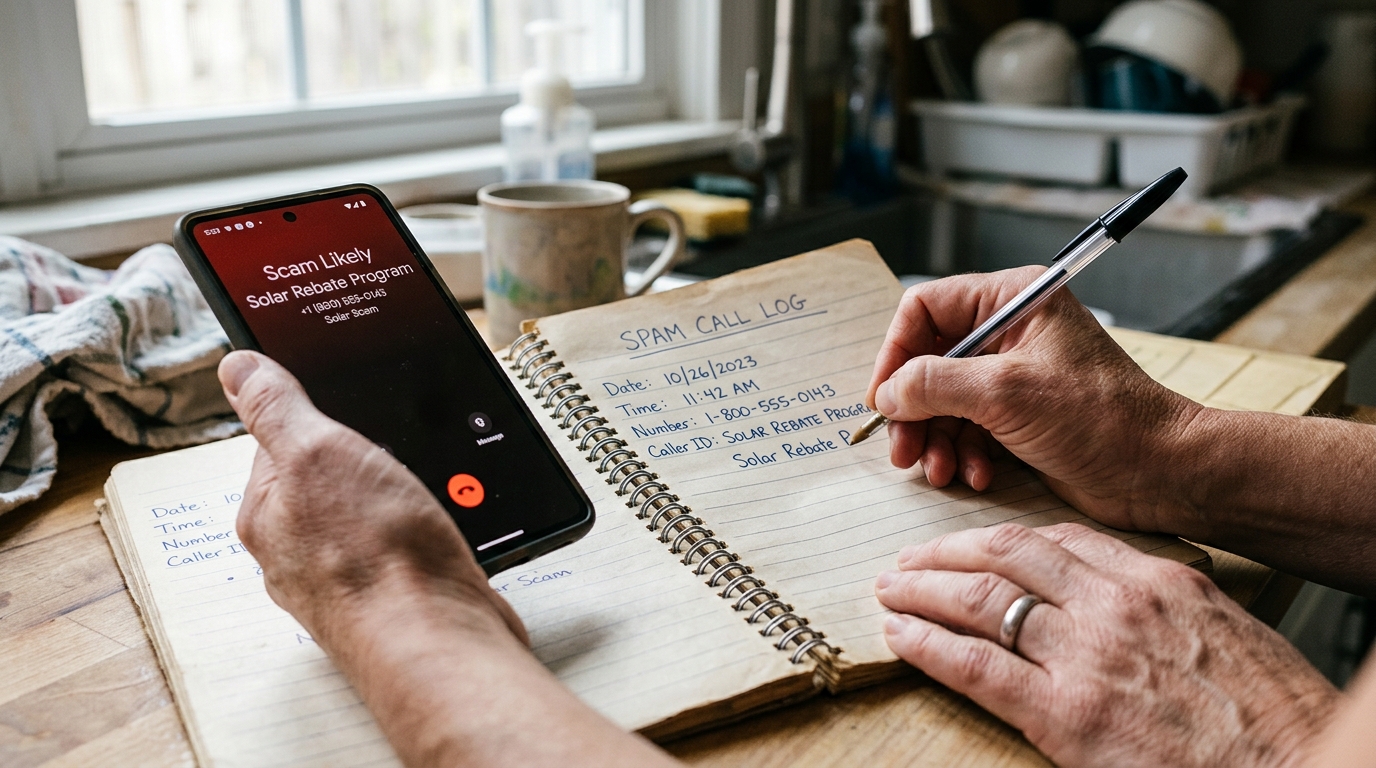
- Admissible Evidence Is Key A winning case requires an exact call log, phone carrier billing records, screenshots of spoofed numbers, and written revocations of consent.
The Solar Robocall Machine: How the Scam Operates
                          The Solar Telemarketing Machine
                                         │
     ┌───────────────────────────────────┴───────────────────────────────────┐
     ▼                                                                       ▼
Offshore Call Centers (VoIP Spoofing)                         The Domestic Lead Buyer
Autodialers blast thousands of calls daily                    Local solar installation companies buy
using fake caller IDs matching your area code.                appointments for $150 to $400 each.
                                         │
                                         ▼
                 Federal Law Connects the Two via Vicarious Liability
1. Offshore Autodialers and VoIP Spoofing
Most predatory solar telemarketing does not originate from American sales offices. Instead, lead-generation aggregators hire overseas call centers (frequently located in the Philippines, Pakistan, or Central America) that use automated dialing systems and artificial voice technology.
- The autodialers use caller ID spoofing to display local numbers matching your area code and prefix ("neighbor spoofing") to trick you into picking up.
- Callers pose as generic government programs ("The American Green Energy Initiative") to avoid naming the underlying solar contractor who paid for the campaign.
2. The Domestic Lead Buyers
Once an offshore telemarketer finds an interested homeowner who owns their roof and pays over $100 monthly for power, they do not install panels themselves. They package your information into a "warm lead appointment" and sell it to a domestic solar installation dealership or financing partner for $150 to $400 per booked lead.
Federal Law: The Telephone Consumer Protection Act (TCPA)
Enacted under 47 U.S.C. § 227, the TCPA strictly regulates telemarketing calls, text messages, and automated telephone dialing systems (ATDS).
Core Statutory Violations
- Automated Calls to Cell Phones (§ 227(b)(1)(A)) It is illegal to place any call or send any SMS text message to a mobile telephone using an autodialer or an artificial/prerecorded voice without the recipient's prior express written consent.
- National Do Not Call Registry Violations (§ 227(c)) It is illegal to place more than one telephone solicitation call within any 12-month period to a residential or cell phone number registered on the National Do Not Call Registry (47 C.F.R. § 64.1200(c)(2)).
- Internal Do Not Call Violations Telemarketers must maintain an internal company-specific DNC list. Once you verbally demand: "Place me on your internal Do Not Call list," any subsequent call constitutes an immediate statutory violation.
- Failure to Identify (§ 64.1200(d)(4)) Telemarketers must immediately disclose the individual caller’s name, the legal name of the person or entity on whose behalf the call is being made, and a telephone number or address.
The FCC's Landmark 1-to-1 Consent Rule
For years, lead aggregators tricked consumers on websites (such as "compare-solar-quotes.com") by inserting tiny font disclaimers stating: "By clicking submit, you consent to receive calls from our marketing partners." Clicking that button shared the homeowner's data with over 5,000 corporate lead buyers.
The FCC closed this loophole:
- The FCC established that consent must be obtained for each individual seller on a one-to-one basis.
- Multi-partner "blanket consent" check-boxes are invalid under federal law.
- If a solar company calls you based on a lead purchased from a multi-party lead aggregator, that company has violated the TCPA and possesses zero valid consent.
Holding the Solar Company Vicariously Liable
When homeowners discover they were called from a spoofed VoIP number, they often despair: "How can I sue a fake number?"
Under binding federal precedent (In re DISH Network, LLC, 28 FCC Rcd 6574), the Federal Communications Commission and federal appellate courts have firmly established the doctrine of vicarious liability:
- The Rule A seller (the solar installation company) can be held legally liable under federal common-law principles of agency for TCPA violations committed by third-party telemarketers who call on the seller’s behalf.
- If the solar company contracts with a lead broker, accepts appointments booked by illegal robocalls, and sends sales reps to those homes, the solar company cannot hide behind the independent contractor defense. The company that reaped the financial benefit of the illegal marketing must pay the statutory damages.
How to "Bait and Unmask" the Real Solar Company
To win a TCPA settlement or judgment, you must identify the domestic corporation purchasing the leads. Follow this battle-tested playbook.
                          The "Bait & Unmask" Playbook
                                       │
1. Answer the Call ──► Act interested; never argue or hang up.
        │
2. Schedule the In-Home Quote ──► Agree to a free site assessment.
        │
3. Collect the Sales Paperwork ──► Get the rep's business card, proposal, and company entity.
        │
4. Serve the TCPA Demand Letter ──► Demand $500–$1,500 statutory damages per call.
- Do Not Hang Up or Yell If you shout "Stop calling me!", the offshore agent will immediately disconnect and mark your number for resale.
- Play Along as an Ideal Lead Feign interest. Confirm that you own your single-family home, your roof is in good condition, and your electric bill is over $150 per month.
- Agree to an In-Home Consultation Allow the caller to dispatch a local sales representative to your home for a "free solar analysis."
- Capture the Domestic Contractor's Identity When the salesperson arrives at your doorstep:
- Ask for their physical business card.
- Note their corporate email address and contractor license number.
- Obtain a written or digital solar proposal showing the exact legal entity name and corporate address.
- Request the Lead Source Ask the rep casually: "Hey, who called me to set this up? I want to make sure the phone agent gets credit." Often, the rep will gladly provide the marketing campaign name or referral portal code.
The TCPA Pre-Suit Demand Letter
Once you have identified the domestic solar contractor, do not rush to court immediately. Serve a formal TCPA Pre-Litigation Settlement Demand via Certified Mail with Return Receipt Requested:
- State the Facts Cite the dates, times, and spoofed caller IDs of every call received.
- Document DNC Registration Attach proof showing your phone number was registered on the National Do Not Call Registry for more than 31 days prior to the first call.
- Assert Vicarious Liability State that the company accepted the benefit of unlawful telemarketing leads and is vicariously liable under 47 U.S.C. § 227.
- Calculate Statutory Damages Multiply the number of illegal calls by $1,500 (for willful violations). For example, three illegal calls equal $4,500 in statutory damages.
- Demand Settlement Provide twenty (20) business days for the company to tender payment before you file a formal lawsuit in small claims or federal district court.
Solar companies know that defending TCPA lawsuits costs $15,000 to $30,000 in defense legal fees, and they frequently settle meritorious individual consumer claims quickly.
Start the eligibility review → to evaluate whether your solar spam call log qualifies for individual statutory recovery or mass-arbitration resolution.
FAQ
How much money can I get for a solar robocall?
Under the Telephone Consumer Protection Act (47 U.S.C. § 227), you are entitled to $500 per call or text placed in violation of the statute. If the court or arbitrator determines the telemarketer committed the violation "willfully or knowingly," damages increase to $1,500 per call.
What if the solar company called from a spoofed or fake number?
Caller ID spoofing is a separate federal violation under the Truth in Caller ID Act. By playing along with the phone pitch and booking a consultation, you can identify the local solar contractor that purchased the lead, holding that domestic company vicariously liable for the illegal call.
Can I sue if I never answered the call?
Yes. Courts have repeatedly held that unattended autodialed calls that ring your phone or leave automated voicemails constitute an invasion of privacy actionable under the TCPA, regardless of whether you personally picked up the receiver.
Does the National Do Not Call Registry stop text messages too?
Yes. The FCC and federal courts treat SMS text messages as "calls" under the TCPA. Unsolicited marketing text messages sent to numbers on the National DNC Registry or sent via automated texting platforms without express written consent are subject to the same $500 to $1,500 statutory penalties.
Next Research Steps
Use these resources to connect this issue with the broader solar scam pattern, the relevant legal framework, and the next practical action.
Solar panel scams
Start with the main solar panel scams guide for the broad definition and recovery roadmap.
Homeowner legal rights
Review cancellation, rescission, UDAP, TILA, Holder Rule, arbitration, and lawsuit options.
Solar financing fraud compensation
Use this guide for loan, dealer-fee, payment-jump, PACE, lease, and lender-defense issues.
Misled by a solar company?
Free 24-hr review · Statutory fee-shifting