Houston Solar Roof Damage Lawyer: Leaks & Install Claims
How Houston homeowners hold solar installers liable for roof leaks, missed rafters, voided shingle warranties, and property damage under the Texas DTPA.
Disclaimer: This article provides factual consumer legal education, construction defect analysis, and statutory dispute procedures under Texas law. It does not constitute formal legal advice. If your roof is actively leaking or has sustained structural damage from a solar installation, consult a qualified Texas construction or consumer-protection attorney.
Overview
In the greater Houston area—from Katy and Sugar Land to The Woodlands and Pearland—homeowners face severe subtropical thunderstorms, Gulf hurricanes, and torrential flash floods. When a rogue or incompetent solar installation crew drives dozens of lag bolts through your roof decking without proper flashing, it is not a matter of if your roof will leak, but when.
Following major weather events like Hurricane Beryl and seasonal tropical storms, hundreds of Houston homeowners discover water pouring through ceiling drywall, rotting attic rafters, and blooming toxic black mold. When they contact their solar company, they run into a wall of corporate evasion:
- The installer claims the roof was "pre-existing and old."
- The installer blames an "unauthorized independent subcontractor" and disclaims all liability.
- Your homeowners insurance carrier denies the claim, citing policy exclusions for faulty workmanship or improper installation.
Under Texas law, you do not have to absorb thousands of dollars in structural roof repairs. The Texas Deceptive Trade Practices Act (DTPA) and Texas common law hold primary solar contractors strictly accountable for shoddy workmanship, breach of warranty, and property damage caused by their installation crews.
Key Takeaways
- The Anatomy of Solar Roof Leaks The vast majority of solar leaks stem from crews missing structural trusses ("missed rafters") and driving lag bolts directly through thin plywood decking without metal step flashing or approved sealant.
- Voided Shingle Warranties Drilling unauthorized penetrations through asphalt shingles automatically voids 25- to 30-year manufacturer warranties (such as GAF or Owens Corning) across the entire affected roof slope.
- Texas DTPA Treble Damages Failing to install solar mounting hardware in a good and workmanlike manner is actionable under Texas Business and Commerce Code § 17.50, allowing homeowners to recover up to three times their actual repair costs plus attorneys' fees.
- The "Subcontractor Shield" Is Invalid in Texas Under Texas Supreme Court precedent, a general contractor cannot escape liability for defective residential construction simply by subcontracting the physical labor to a third party.
- The Insurance Coverage Trap Homeowners insurance policies routinely deny interior water damage if the primary cause of intrusion was improper contractor penetrations rather than direct storm-created openings.
How Incompetent Solar Crews Destroy Houston Roofs
                      The Unflashed Penetration Failure
                                      │
     ┌────────────────────────────────┴────────────────────────────────┐
     ▼                                                                 ▼
Missed Trusses / "Blind Lagging"                  Omitted Metal Step Flashing
Crews miss 2x4 rafters; lag bolts anchor          Installers squirt cheap silicone caulk
into thin 7/16" OSB decking, tearing loose        over shingle holes instead of slipping
under hurricane wind uplift.                      code-compliant aluminum flashing beneath.
1. Blind Lagging and Missed Rafters
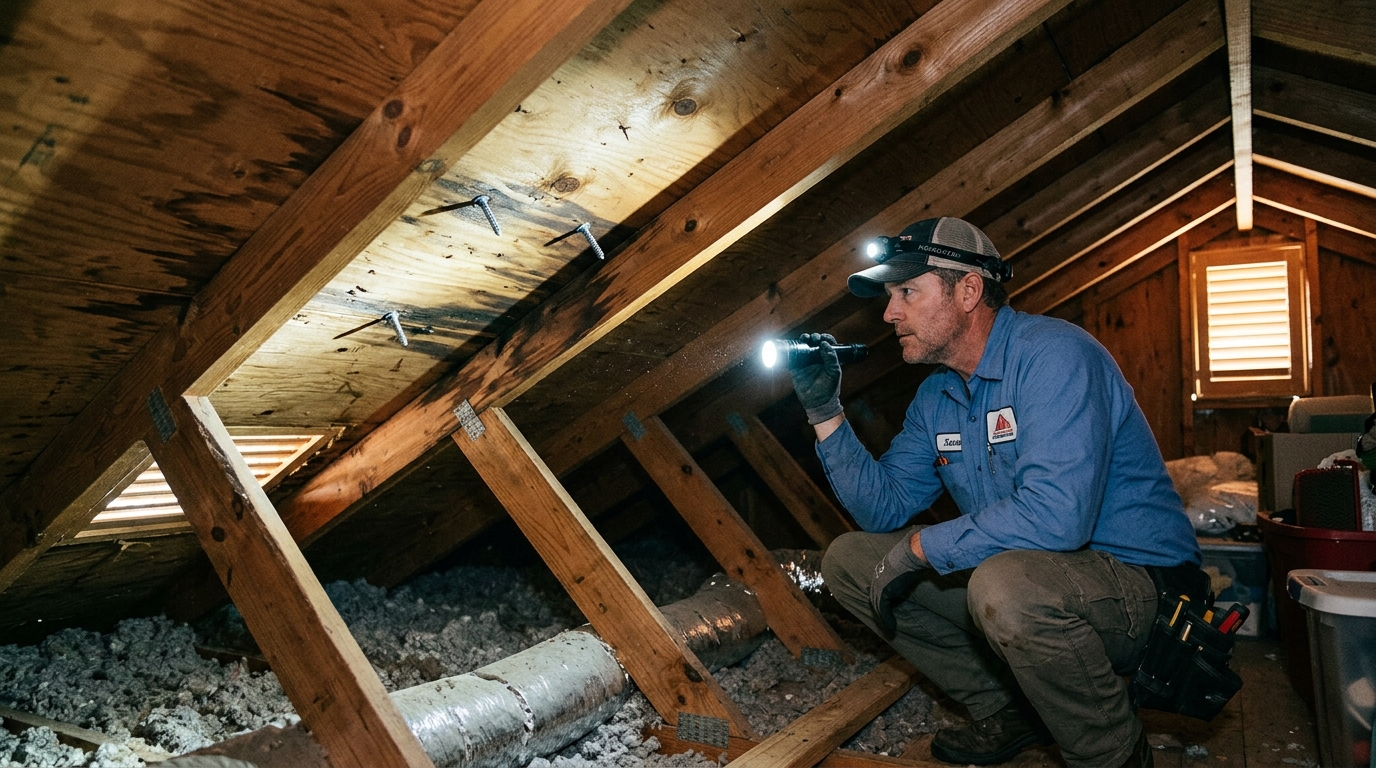
Solar racking systems require heavy lag bolts to be driven directly into the center of the structural roof rafters. Rushed, commission-driven installation crews frequently fail to locate rafters from inside the attic. Instead, they drill blindly from the roof surface.
When a bolt misses the rafter, it penetrates only the thin 7/16-inch Oriented Strand Board (OSB) or plywood roof decking. This creates two catastrophic failure modes:
- Zero Structural Hold In high Gulf Coast winds, the panels act like a giant sail. The bolts pull free from the splintered decking, tearing gaping holes in your roof during storms.
- Open Conduits for Water Rainwater pools around the unanchored bolt and channels directly down attic framing onto ceiling drywall.
2. Omitted Flashing and Reliance on "Roof Goo"
Under the International Residential Code (IRC) and local Houston municipal building amendments, all roof penetrations must be protected with approved, weather-resistant metal flashing.
Subcontracted solar crews routinely cut corners:
- Rather than lifting shingles and sliding code-compliant aluminum flashing beneath the upper course, workers simply drill through the shingle and squirt cheap polyurethane sealant or silicone caulk over the bolt head.
- In Houston’s intense summer heat—where roof surface temperatures routinely exceed 150°F—topical sealants bake, shrink, crack, and peel away within 12 to 24 months. When Gulf squalls hit, high-pressure rain is forced beneath the shingles directly into your attic.
3. Destruction of the Shingle Manufacturer Warranty
Roofing manufacturers like GAF, CertainTeed, and Owens Corning strictly outline installation guidelines. When solar crews hammer mounting brackets into existing shingles, tear away granules, or compromise underlayment, the manufacturer’s 30-year shingle warranty is immediately voided across that entire roof plane.
If an installer causes widespread penetration leaks, replacing individual shingles is rarely sufficient—the entire roof slope must be stripped down to the decking and replaced to restore water integrity.
Texas Law: Defeating the "Subcontractor Defense"
When Houston homeowners confront solar companies about water intrusion, corporate representatives almost universally deploy the same excuse: "We didn't install the panels; we used an independent local roofing subcontractor. You have to sue them."
Under Texas law, this defense is completely legally defective.
1. The Non-Delegable Implied Warranty of Good Workmanship
Under established Texas Supreme Court precedent (Centex Homes v. Buecher, 95 S.W.3d 266), residential construction contractors owe an implied warranty to perform work in a good and workmanlike manner.
This implied warranty cannot be waived or disclaimed in boilerplate contract language. When a solar company contracts with a Texas homeowner to install a rooftop solar system, the prime contractor remains vicariously liable for all construction defects and property damage caused by any subcontractor it assigns to your home.
2. Texas DTPA Causes of Action for Roof Damage
Under the Texas Deceptive Trade Practices Act (Tex. Bus. & Com. Code § 17.41 et seq.), homeowners have robust statutory claims against solar installers for:
- Breach of Express and Implied Warranties Representing that the installation would be watertight and backed by a "roof penetration guarantee."
- Section 17.46(b)(7) Representing that goods or services are of a particular standard, quality, or grade if they are of another.
- Unconscionable Action Taking advantage of the consumer’s lack of construction expertise to a grossly unfair degree.
If the installer committed these violations knowingly or intentionally—such as ignoring documented site survey warnings that a roof was unsuitable for solar—the homeowner can recover three times their actual economic damages (treble damages), including the complete cost of full roof replacement, interior drywall repair, mold remediation, plus mandatory attorneys' fees.
The Insurance Claim Minefield: Why Homeowners Get Denied
Many Houston homeowners assume that if water enters their home during a severe weather event like Hurricane Beryl, their standard homeowner's insurance policy will cover the damage.
Beware the insurance coverage gap
Storm Damage (Wind Tearing Shingles) ──► Generally Covered by Homeowners Insurance
                          VS.
Improper Lag Bolt Penetrations ──► EXCLUDED under "Faulty Workmanship" Clauses
When an insurance adjuster inspects a leaking solar roof, they look specifically for contractor negligence. If the adjuster determines that water entered through unflashed lag bolts or missed rafter penetrations, the insurance company will issue a formal denial letter citing the policy's "Faulty, Inadequate, or Defective Workmanship" exclusion.
You are left holding a $25,000 roof replacement bill, an active $80,000 solar loan, and water ruining your home. In this scenario, your sole legal recourse is to pursue the solar contractor and its general liability insurance policy.
4-Step Emergency Action Plan for Houston Homeowners
If your roof is leaking after a solar installation.
Step 1: Mitigate the Damage Immediately
Texas law imposes a duty on homeowners to take reasonable steps to prevent further property loss:
- Place buckets, tarp attic insulation, and run dehumidifiers to prevent mold growth.
- Keep every receipt for tarps, emergency roofers, and water extraction services—these are recoverable out-of-pocket consequential damages.
Step 2: Hire an Independent Forensic Roofing Inspector
Do not let the solar company's own "repair technician" inspect the roof alone. Unscrupulous installers will apply a quick bead of mastic caulk to hide the missed rafters before an independent expert can document the defect.
- Hire an independent, Haag-certified Texas roofing inspector.
- Ensure the inspector accesses both the roof exterior (to document missing flashing and cracked shingles) and the attic interior (to photograph missed rafters, daylight through decking, rotted wood, and wet insulation).
Step 3: Serve the 60-Day Texas DTPA Pre-Suit Demand
Have legal counsel serve a formal written 60-Day DTPA Demand Letter on the solar company and its registered agent via Certified Mail:
- Detail the specific construction defects and enclose the forensic roofing report.
- Itemize the total cost of complete roof restoration, interior sheetrock replacement, mold remediation, and temporary living expenses.
- Demand that the solar company immediately tender full financial payment and instruct the loan servicer to freeze solar financing payments during remediation.
Step 4: Demand the Solar Contractor's Commercial General Liability (CGL) Policy
Do not sue a shell installer without discovering their insurance coverage. Demand the contractor's Certificate of Insurance (COI) and tender an immediate third-party property damage claim directly to their commercial insurer.
Start the eligibility review → to evaluate your Houston solar roof damage claim and explore your legal options under the Texas DTPA.
FAQ
Will the solar company pay for my new roof if they caused leaks?
Under the Texas DTPA and common-law breach of contract, a solar company is legally obligated to repair all direct and consequential property damage caused by its unworkmanlike installation. If the penetrations were widespread or compromised the structural integrity of the roof, the installer can be held liable for the cost of a full roof replacement.
Can I sue the solar company if my homeowners insurance denied my leak claim?
Yes. An insurance denial based on "faulty workmanship" provides strong evidence against the solar installer. The denial establishes that the damage was directly caused by the contractor's defective installation rather than an act of God, supporting your legal claims against the contractor’s commercial liability policy.
Who is responsible if the solar installer used an independent roofing subcontractor?
Under Texas law, the primary solar company with whom you contracted owes an implied warranty of good and workmanlike construction that cannot be delegated away. The prime contractor is vicariously liable for all property damage caused by its chosen subcontractors.
Can I stop paying my solar loan while my roof is leaking?
If you financed the installation through a home improvement lender (such as GoodLeap or Mosaic), federal law under the FTC Holder Rule (16 C.F.R. § 433.2) allows you to assert your property damage and breach of contract claims against the lender. You should issue a formal written dispute and consult with legal counsel before unilaterally stopping payments to avoid unlawful credit bureau damage.
Next Research Steps
Use these resources to connect this issue with the broader solar scam pattern, the relevant legal framework, and the next practical action.
Solar panel scams
Start with the main solar panel scams guide for the broad definition and recovery roadmap.
Homeowner legal rights
Review cancellation, rescission, UDAP, TILA, Holder Rule, arbitration, and lawsuit options.
Solar fraud by state
Compare state and city issues against the national solar fraud map.
Solar company complaint directory
Look up installers, lenders, bankruptcies, warranty problems, and customer-service complaint patterns.
Misled by a solar company?
Free 24-hr review · Statutory fee-shifting