Is Solar a Scam? Truth About Solar Panels vs. Sales Scams
Is solar a scam? Learn the difference between legitimate solar technology and solar sales scams. Understand real risks and how to avoid solar scams.
Listen: Is Solar a Scam? Truth About Solar Panels vs. Sales Scams
Spoken audio investigation (9 min narration)
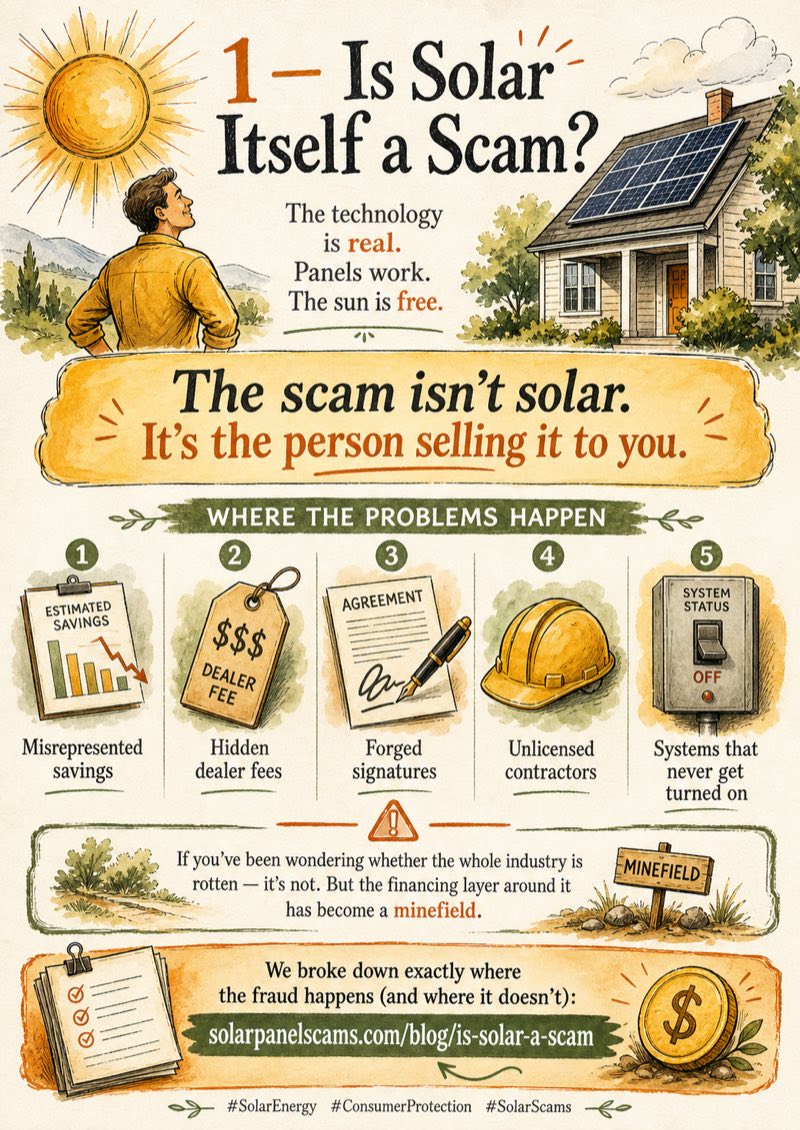
Is solar a scam? No — solar technology itself is legitimate and proven. The scam lives in the sales and financing layer, where misrepresented savings, undisclosed dealer fees, forged signatures, and unlicensed contractors turn a real product into a bad deal. Six major solar installers collapsed between 2024 and 2026, affecting over 1.3 million homeowners, according to the 2026 Solar Scam Report.
This guide separates fact from fiction, explains where scams actually occur, and helps you make an informed decision about solar for your home.
The most important distinction is simple: solar panels can be real and useful while a particular solar deal is abusive. Most consumer harm begins in the sales and financing layer: savings projections that do not match utility reality, dealer fees hidden in loan principal, rushed e-signatures, unlicensed contractors, and systems that never reach permission to operate.
Key takeaways at a glance
- Solar technology is a proven, legitimate energy source deployed on over 4 million U.S. homes — the scams are in the sales process, not the panels themselves.
- Deceptive sales tactics like "free solar," fake government programs, and inflated savings projections pressure homeowners into signing bad contracts.
- Complex 20–25 year contracts often hide dealer fees of 15–30%, escalating PPA payments, and difficult exit terms buried in fine print.
- Always get 3+ quotes, verify licenses independently, and never sign under pressure — legitimate solar offers do not expire today.
- Solar is a smart investment when you pay cash, vet the installer, and have a suitable roof — but predatory financing traps can erase every dollar of projected savings.
The Short Answer
Solar panels are not a scam. The technology works, generates real electricity, and has been deployed successfully on millions of homes for decades.
Solar sales scams ARE a real problem. Deceptive practices, misleading financing, and high-pressure tactics have cost consumers millions.
The distinction matters You can benefit from solar technology while avoiding scammy companies by understanding where the risks lie.
Solar Technology: Why It Works
Proven Science, Real Results
Solar photovoltaic (PV) technology converts sunlight directly into electricity using semiconductor materials—primarily silicon. This isn't experimental technology:
- First practical solar cell 1954 at Bell Labs
- NASA used solar in space missions since the 1960s
- Grid-connected solar Over 4 million U.S. homes have solar panels
- Global capacity Over 1,400 gigawatts installed worldwide
The physics is settled science. Solar panels work as advertised—they convert sunlight to electricity predictably and reliably. If you want the plain-English version of how a home system actually works, read what solar power really is; if you have heard the opposite from a skeptical relative, see the five most common "solar panels are a joke" myths.
Real Benefits of Solar
When installed properly by reputable companies, solar provides:
- Financial Benefits
- Reduced electricity bills – Generate your own power
- Net metering credits – Sell excess back to grid
- Federal tax treatment – Section 25D does not apply to expenditures treated as made after December 31, 2025; qualifying 2025 installations may still matter for returns or carryforwards
- Increased home value – Studies show 3-4% premium
- Fixed energy costs – Hedge against utility rate increases
Practical Benefits
- 25-30 year lifespan – Quality panels are durable
- Low maintenance – Minimal upkeep required
- Energy independence – Reduce reliance on utility grid
- Battery backup options – Power during outages
Environmental Benefits
- Reduced carbon footprint – Clean electricity generation
- Renewable resource – Sunlight is free and abundant
- Reduced grid demand – Helps overall system stability
Where Solar Scams Actually Occur
The Sales Problem
The scam isn't in the technology—it's in the sales process. Solar companies have adopted aggressive tactics common to industries with high-pressure sales:
- Door-to-door canvassing – Unsolicited high-pressure visits
- Telemarketing – Robocalls and spam calls
- Misleading savings projections – Inflated financial benefits
- Hidden financing costs – Dealer fees, escalator clauses
- Phantom government programs – Fake incentives that don't exist
- Today-only pricing – Pressure tactics to prevent research
The Contract Problem
Complex, long-term contracts create opportunities for abuse:
- 20-25 year commitments – Locked in for decades
- Difficult exit terms – Expensive or impossible to cancel
- Escalating payments – Annual increases hidden in fine print
- Transfer complications – Problems when selling home
- Lien issues – Financing liens clouding property titles
The Financing Problem
Solar financing has become a profit center rife with abuses:
- Dealer fees of 15-30% – Hidden in loan principal
- Misrepresented APR – Interest rate vs. true cost
- Prepayment penalties – Trapping borrowers
- Variable rate loans – Payment unpredictability
- Aggressive loan sales – Pushing financing over cash purchases
The Installation Problem
Quality control varies dramatically
- Unlicensed contractors – Illegal installations
- Substandard work – Roof leaks, electrical hazards
- Ghost installers – Take deposits, disappear
- Counterfeit equipment – Fake panels and inverters
- No permits pulled – Code violations and safety issues
Common Solar Scam Tactics
The "Free Solar" Lie
The pitch "Free solar panels! No cost to you!"
The reality This is a solar lease or PPA, not free panels. You'll pay:
- Monthly payments for 20-25 years
- Annual escalators (payment increases)
- Total cost often exceeds purchase price
- No ownership or tax credits
Why it's deceptive "Free" refers to $0 down payment, not $0 total cost.
The Government Program Scam
The pitch "Federal solar program ends soon! Qualify today!"
The reality
- No federal door-to-door solar program exists
- The old residential credit schedule ended for expenditures after December 31, 2025. Check the 2026 federal solar tax-credit rules rather than accepting a salesperson's amount or timing claim.
- State programs don't require immediate sign-up
- Any "emergency" deadline is artificial pressure
Legitimate incentives Database of State Incentives for Renewables & Efficiency (DSIRE)
The Misleading Savings Projection
The pitch "Your $200 electric bill will drop to $20!"
The reality
- Savings depend on your usage, roof, shading, and rates
- Many assumptions are optimistic
- Actual savings often 50-70% of projections
- Some customers see bills increase
Reality check If it sounds too good to be true, it probably is.
The Financing Trap
The pitch "0.99% interest! Zero down!"
The reality
- Interest rate ≠ true cost
- Dealer fees of 20%+ hidden in principal
- True APR often 6-12%
- Total cost thousands higher than cash price
Example $30,000 system becomes $36,000 loan with dealer fee. You pay interest on $36,000.
How to Avoid Solar Scams
Step 1: Work With Reputable Companies
Green flags
- Licensed and insured
- Physical local office
- 5+ years in business
- Positive reviews (look for patterns, not just stars)
- BBB accreditation (though not perfect)
- NABCEP-certified installers
Red flags
- Door-to-door solicitation
- "Today only" pricing
- No verifiable address
- Recent business formation
- Pattern of complaints
Step 2: Get Multiple Quotes
Minimum 3 quotes from different companies
What to compare
- Price per watt (standardized metric)
- Equipment brands and models
- System size and production estimates
- Warranty terms
- Financing options (if needed)
Huge price differences = caution. The cheapest may cut corners; the most expensive may be gouging.
Step 3: Understand the Financing
Before signing any financing
- Get the total loan amount including ALL fees
- Calculate the true APR (not just interest rate)
- Ask about dealer fees specifically
- Compare with credit union or bank loans
- Consider home equity options
Golden rule If you don't understand the financing completely, don't sign.
Step 4: Read the Entire Contract
Never sign at the door. Take 24-48 hours minimum to review.
Critical contract elements
- Exact equipment specifications
- Production guarantees
- Total cost and payment schedule
- Warranty terms
- Cancellation rights
- What happens if you sell your home
If they pressure you to sign immediately, walk away.
Step 5: Verify Everything Independently
Don't rely on sales presentations
- Verify licenses with state contractor board
- Check complaint history at BBB and state AG
- Research equipment independently
- Get solar production estimates from multiple sources
- Confirm incentives on government websites
Is Solar Worth It? The Real Answer
When Solar Makes Sense
Solar is likely worth it if
- You own your home and plan to stay 7+ years
- Your roof is in good condition (south-facing ideal)
- You have high electricity bills ($150+/month)
- Your utility has favorable net metering
- You can pay cash or get low-cost financing
- You work with a reputable installer
When Solar Doesn't Make Sense
Solar may NOT be worth it if
- You rent or plan to move within 5 years
- Your roof needs replacement soon
- Your home is heavily shaded
- Your electricity bills are already low
- Your utility has poor net metering terms
- You can't find a reputable installer
- The financing costs are excessive
The Math
Conservative savings calculation
Annual Production (kWh) × Your Electricity Rate = Gross Savings
Minus: Financing Costs
Minus: Maintenance/Insurance
Minus: Inverter Replacement (~year 12)
Minus: Panel Degradation (~0.5%/year)
= True Annual Savings
Example realistic scenario
- 8 kW system producing 11,000 kWh/year
- At $0.14/kWh = $1,540 gross savings
- Minus $800/year loan payment
- Net savings: ~$740/year
- Payback: 12-15 years on a $20,000 system
FAQ: Common Questions About Solar Scams
Is solar a pyramid scheme?
No. Solar panels are physical products, not recruitment schemes. However, some solar companies use multi-level marketing structures for sales, which can create problems. Stick with traditional installers, not MLM solar sales.
Do solar panels really work?
Yes. Solar panels convert sunlight to electricity reliably for 25-30 years. The technology is proven and deployed globally. Performance varies based on installation quality, equipment, and location—but the technology itself is legitimate.
Why are there so many solar scams?
Market conditions enable scams
- High consumer demand for energy savings
- Complex products consumers don't understand
- Large transaction sizes ($20,000-$40,000)
- Aggressive commission structures
- Limited regulatory oversight
- Long-term contracts that hide problems
Can I trust solar companies?
Some yes, some no. The industry has both reputable installers and scammers. Your protection comes from:
- Thorough research
- Multiple quotes
- Contract review
- Verification of claims
- Never signing under pressure
What if I already signed with a questionable company?
You may have options
- 3-day cooling-off period – Federal right to cancel door-to-door sales
- State rescission laws – Some states have longer periods
- Contract defects – If terms were misrepresented
- Legal action – Consult an attorney if scam occurred
Bottom Line
Solar technology is real and beneficial for many homeowners. The scam risk isn't in the panels themselves—it's in the sales and financing practices of some companies.
Your protection strategy
- Research thoroughly before committing
- Get multiple quotes
- Read contracts completely
- Verify all claims independently
- Never sign under pressure
- Understand financing true costs
Solar can be a smart investment when you work with reputable companies and make informed decisions. The key is separating the legitimate technology from the scammy sales practices.
Official Sources to Verify the Difference
Use these sources to separate legitimate solar technology from deceptive solar sales:
- The Department of Energy explains how residential solar works, when it can save money, and what factors affect the economics: DOE guide to whether solar saves money.
- The Department of Energy's consumer resources cover choosing, installing, financing, and maintaining a home solar system: DOE solar energy resources for consumers.
- The Department of Energy explains the differences between solar loans, leases, PPAs, and cash purchases: DOE homeowner's guide to solar financing.
- The FTC warns that false "free solar," utility-affiliation, government-affiliation, cost, savings, tax credit, and financing claims are scam indicators: FTC guidance on solar scams.
- Use DSIRE to check incentives directly instead of trusting a sales claim: Database of State Incentives for Renewables and Efficiency.
Related Resources
- How to Avoid Solar Panel Scams: 7 Verification Steps
- Solar Panel Scams and Rip-Offs: Field Guide
- How to Spot Solar Panel Scams: Red Flags
- Sunrun Reviews: Complaints and Costs
Have questions about whether solar is right for you? Our consumer research team can help you evaluate offers and identify potential red flags. We don't provide legal advice, but we can share research and resources.
Next Research Steps
Use these resources to connect this issue with the broader solar scam pattern, the relevant legal framework, and the next practical action.
Solar panel scams
Start with the main solar panel scams guide for the broad definition and recovery roadmap.
Solar panel scams and ripoffs
Compare scam patterns, red flags, door-to-door pressure, fake rebates, and impersonation tactics.
Solar financing fraud compensation
Use this guide for loan, dealer-fee, payment-jump, PACE, lease, and lender-defense issues.
Misled by a solar company?
Free 24-hr review · Statutory fee-shifting